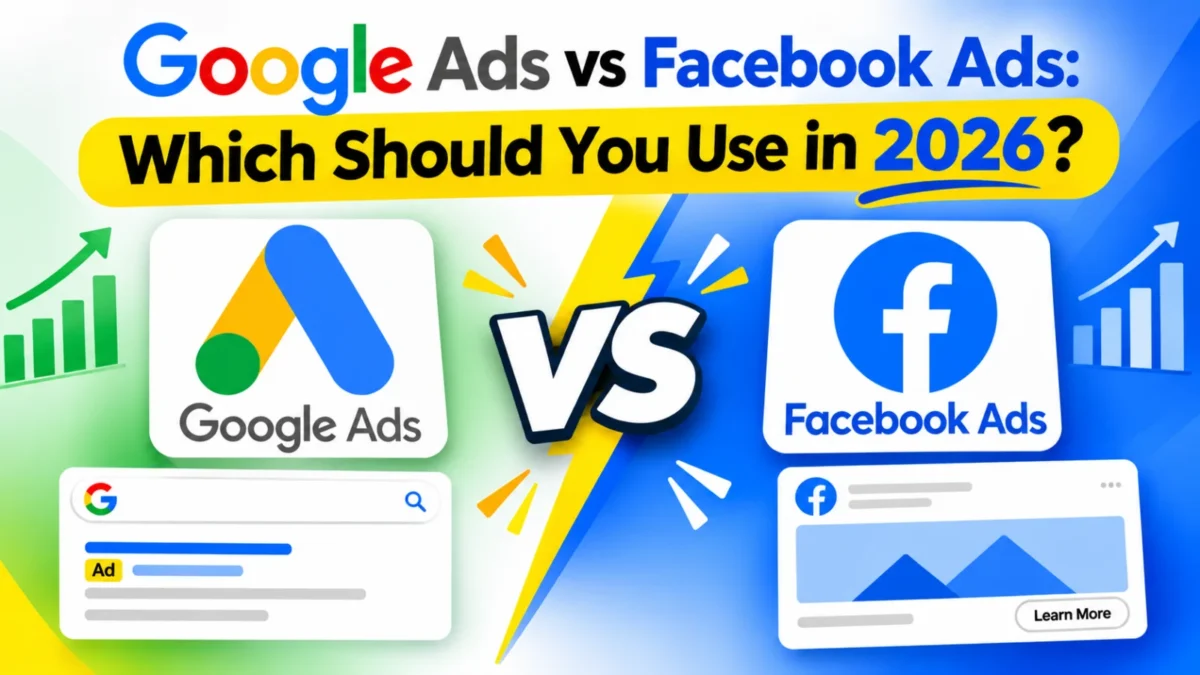
If you can only afford one, use Google Ads when people already search for what you sell, and use Facebook Ads when they don’t yet know you exist. That single rule settles most cases. The rest of this article shows you how to test it against your own business, what each platform really costs, and how to run both without wasting money.
Short answer: Google Ads captures existing demand from people typing a need into a search box. Facebook Ads (which now run through Meta’s system and reach Instagram too) creates demand by showing your offer to people who match a profile. Google clicks cost more but usually come from people closer to buying. Facebook clicks cost less but usually need more nurturing. Many businesses end up using both, in a set order.
The real difference: demand you capture and demand you create
People often describe this as paid search against paid social, which is accurate but not very helpful. A better way to think about it is the state of mind of the person who sees your ad.
Someone who types “emergency plumber near me” into Google wants a plumber now. Your ad is an answer to a question they asked. Someone scrolling Facebook on a break wasn’t looking for a plumber, a course or a pair of shoes. Your ad interrupts what they were doing, so it has to earn attention in a second or two.
That difference explains almost everything else: why Google clicks cost more, why Facebook targeting is so detailed, why Facebook ads lean on pictures and video, and why the two platforms work well together.
| Google Ads | Facebook Ads (Meta) | |
|---|---|---|
| Who sees your ad | People searching, watching or browsing Google properties | People using Facebook, Instagram, Messenger and partner apps |
| Main targeting logic | What people search for | Who people are and how they behave |
| Typical intent | High on Search, lower on video and display | Low to medium, higher when retargeting |
| Cost per click | Higher | Lower |
| Best at | Capturing demand that already exists | Creating awareness and interest |
| Creative effort | Moderate on Search, higher on video | Constant, since ads tire out quickly |
How Google Ads works
Every time someone searches, Google runs an auction among the ads that could match. Your bid matters, but it isn’t the only thing. Google’s own explanation of the auction lists six factors: your bid, the quality of your ad and landing page, the expected impact of ad assets such as phone numbers and extra links, a minimum Ad Rank threshold, the context of the search, and how competitive the auction is. Your bid is the most you’re willing to pay, and what you actually pay is often less.
For a small advertiser, this is good news. A relevant ad that sends people to a fast, clear page can win a better position than a competitor who simply bids higher. It also means a weak landing page quietly raises your costs.
More than text ads
Search is the campaign type most people picture, but Google Ads covers more ground than that. Shopping ads show products with photos and prices. YouTube carries video. Performance Max spreads one campaign across Google’s channels using automation. And Demand Gen, which Google describes in its help documentation, serves image, video and carousel ads across YouTube including Shorts, Discover, Gmail and the Display Network. Google has also said that Display campaigns are moving into Demand Gen.
This matters because an old claim still repeats in many comparisons: that Google is for text and Facebook is for visuals. It’s no longer a clean dividing line. Google now has a visual, interest based product of its own. The dividing line that still holds is intent. Search ads meet a stated need. Demand Gen, like Facebook, introduces your brand to people who haven’t asked for it yet.
How Facebook Ads work
Facebook Ads are managed through Meta’s advertising tools, so a single campaign can appear on Facebook, Instagram, Messenger and Meta’s partner apps and sites. You pick a goal such as messages, leads, traffic or sales, define an audience, upload your creative and set a budget.
Targeting is the platform’s famous strength. You can build audiences from demographics, location, interests and behaviors. You can also upload a customer list to create a custom audience, retarget people who visited your website, and build lookalike audiences of people who resemble your best customers. For a niche offer, such as a course for parents of young children in one city, that precision is hard to match.
Meta increasingly leans on automation. According to a Social Media Today summary of Meta’s advice, Meta tells advertisers to stay opted into all placements through Advantage+ placements instead of picking spots by hand. In practice, creative has become the main lever you control. A strong, clear video or image does more than clever audience tweaking.
Cost: what the benchmarks say (and why they disagree)
Anyone shopping for numbers will find them contradicting each other. Here’s what the better sources report, and how to read them.
Google search benchmarks. WordStream by LocaliQ’s 2026 report, covered by Search Engine Journal, looked at Google and Microsoft search campaigns from April 2025 to March 2026. Across all industries, the average cost per click was $5.42, the average click through rate was 6.64%, the average conversion rate was 8.18% and the average cost per lead was $66.69. Legal services topped the CPC list at $9.87, while arts and entertainment was the cheapest at $1.63.
Google against Facebook. AgencyAnalytics publishes its own side by side comparison using median values from its clients’ accounts. In its November 2025 update, Google Ads had a median CPC of $2.29 and a click through rate of 4.26%, while Facebook Ads had a median CPC of $0.49 and a click through rate of 1.81%. Search Engine Land, reporting on WordStream’s Facebook data, notes the same direction: Google’s average CPC is now more than double Meta’s.
The figures differ because the samples, the campaign types and the math (median or average) differ. Don’t mix numbers from different sources in one calculation. What you can safely take away is the direction. Facebook clicks are cheaper, Google clicks are pricier, and both vary enormously by industry and country.
Cheap clicks are not the same as cheap customers
What you really care about is cost per customer or lead. Here’s a simple illustration. These numbers are invented to show the logic, not benchmarks.
| Scenario | Cost per click | Conversion rate | Cost per conversion |
|---|---|---|---|
| Google Search, people ready to buy | $2.50 | 8% | $31.25 |
| Facebook, cold audience | $0.60 | 1.5% | $40.00 |
| Facebook, retargeting past visitors | $0.60 | 4% | $15.00 |
In this example, the expensive Google click produces the cheaper customer than the cold Facebook click. But Facebook retargeting beats both, because the people seeing those ads already know you. That last row only exists once something else has brought visitors to your site, which is one reason the platforms support each other.
Budget size matters too. Say you have $300 a month. At $2.50 a click, that buys about 120 clicks on Google, and at an 8% conversion rate you’d expect around 10 leads. At $0.60 a click, the same money buys about 500 Facebook clicks, and at 1.5% you’d expect around 7 or 8 leads. Your real numbers will differ, but running this sum with your own assumptions before you spend anything is the quickest sanity check available.
Targeting and intent: where each platform earns its keep
Choose Google when a meaningful number of people already search for your product, service or problem. Ask yourself a plain question: would a customer type words into a search box to find this? Emergency repairs, local clinics, legal help, specific product models and software comparisons all pass. If a keyword tool shows almost no searches for your category, Google has little to work with, however good your ads are.
Choose Facebook when your offer is new, visual, impulsive or aimed at a defined group that isn’t searching yet. A new fitness gadget, a boutique, a local event or a niche course won’t get many searches, but it can still find interested people through interests and behaviors.
Two details are easy to miss. First, search intent has layers. Someone typing a brand name or “buy” plus a product name is much closer to purchase than someone typing a broad research question, so keyword choice changes your costs a lot. Second, Facebook intent isn’t fixed. A cold audience has low intent, but someone who watched most of your video or visited your pricing page last week has much higher intent, and you can target them directly.
Tracking and measurement
You can’t compare the platforms fairly if you can’t see what each one produces. Privacy changes have made this harder, especially on the Facebook side. AgencyAnalytics points out that iOS changes and cookie restrictions make conversion tracking on Facebook more difficult, and that advertisers increasingly rely on modeled conversions, UTM tags and GA4 events to keep measurement accurate.
A few habits keep your comparison honest:
- Tag every ad link with UTM parameters so your analytics shows which campaign sent each visitor.
- Count the actions your customers really take. For many small businesses that means phone calls and WhatsApp messages, not just form submissions.
- Keep a simple enquiry log with date, source, product and outcome, and ask each new customer how they found you.
- Judge each platform on cost per qualified lead or sale, not on clicks, likes or impressions.
If you’re still choosing software for this, the best digital marketing tools for small businesses guide covers analytics and tracking options, including free ones.
Which one should you choose? Five common situations
You run a local or urgent service. Start with Google Search. Plumbers, clinics, repair shops, lawyers and movers get customers at the moment of need. Add location targeting, a call button and a landing page that loads fast on a phone.
You sell products people already search for. Google Search and Shopping usually come first, because shoppers type specific product terms. Add Facebook and Instagram retargeting for people who looked and left.
You sell a visual or lifestyle product. Fashion, beauty, food, home decor and events tend to do better when people see the product in motion. Start with Facebook and Instagram video, then add Google once people start searching your name.
You have a new product nobody is looking for yet. Facebook is the better place to build awareness. Nobody searches for something they haven’t heard of, so there’s no search demand to capture yet.
You sell to other businesses. Google captures buyers who search for solutions. Facebook can still help with retargeting website visitors and reaching decision makers, but LinkedIn may deserve a look for some B2B offers too.
If you’re still working out which channels fit your overall plan, the digital marketing strategy for small business guide walks through channel choice by business type.
A note for businesses in Afghanistan and similar markets
Local conditions change the math. According to DataReportal’s Digital 2026 Afghanistan report, the country had about 11.3 million internet users in October 2025 and about 5.00 million active social media user identities. That’s a large audience on social platforms, but a smaller pool of people searching in any one language.
Three practical checks follow from that:
- Check search volume in your own language. Look up your keywords in Dari, Pashto and English before assuming Google has demand to capture. Volume can be thin in some categories.
- Plan for messages, not just forms. Many customers prefer to call or send a WhatsApp message. Make sure your ads and tracking count those actions.
- Confirm payment and policy details first. Payment methods and advertising rules differ by country and currency. Check what your ad account accepts before you plan a campaign.
For more on this, see my guides to digital marketing in Afghanistan and social media marketing in Afghanistan, which cover platform choice, small budgets and measurement for the local market.
Using both: a sensible order
The best-run accounts rarely treat this as a contest. They treat Google and Facebook as two different jobs in the same funnel. Here’s a simple order that works for many businesses.
- Start with Google Search for demand that already exists. Bid on the specific terms your best customers use. This gets you your first measurable leads fastest.
- Add Facebook retargeting once you have visitors. Show past visitors a reminder, a testimonial or an offer. Because these audiences are small and warm, they tend to be cheap and effective.
- Test cold Facebook creative to create new demand. Try two or three short videos or images, one audience at a time, and measure cost per lead rather than clicks.
- Run a branded search campaign. When someone sees your Facebook ad and then Googles your name, make sure your ad is the first thing they find. AgencyAnalytics describes this pairing, along with the reverse one where a Google visitor later sees a Facebook reminder.
How much should each get? There’s no universal split. One agency leader quoted by AgencyAnalytics suggests putting about three quarters of the budget on active searchers and a quarter on the passive audience, adjusting when organic rankings already capture much of the search demand. That’s a reasonable starting point, but your own cost per lead should overrule any rule of thumb after the first month or two.
Paid and organic also feed each other. If people search for your service often enough to justify Google Ads, they’re searching in ways your website can rank for too, which is where SEO services and a plan like the SEO guide for Afghanistan come in. Ads buy attention now. SEO builds it over months. A 90 day schedule in this digital marketing plan template can help you decide how to sequence them.
Mistakes that waste ad money
- Choosing by habit instead of demand. Running Google Ads for a product nobody searches for, or Facebook Ads for an emergency service, fights the platform’s strengths.
- Judging Facebook by last-click sales alone. Facebook often plants the idea that a later Google search finishes. Look at both channels together before cutting either.
- Sending traffic to a weak page. A slow, unclear or desktop-only page wrecks results on both platforms, and on Google it can raise your costs.
- Spreading a tiny budget over both. With very little money, two half-funded campaigns teach you nothing. Fund one properly, learn, then add the other.
- Letting creative go stale. Facebook audiences tire of the same ad quickly. Plan new images and videos every few weeks.
- Ignoring tracking until later. If you can’t tell which calls and messages came from which ad, you’ll make decisions blind.
- Copying benchmark numbers as targets. A benchmark from another industry or country says little about your business. Treat it as a rough reference.
Conclusion
Google Ads and Facebook Ads aren’t rivals so much as tools for different moments. Google meets people when they’re asking. Facebook reaches people before they ask. Start with the one that matches how your customers find businesses like yours, track results from the first day, and add the other platform when the first one gives you data to build on.
If you’d like help choosing, setting up tracking or running campaigns, take a look at my Google Ads and paid advertising services or get in touch with your goals and budget, and I’ll suggest where to start.
Which is cheaper, Google Ads or Facebook Ads?
Facebook clicks are usually cheaper. Several benchmark sources show Google’s CPC at more than double Facebook’s. But Google clicks often convert at a higher rate because the searcher already has a need, so cost per lead or sale can end up closer than the click prices suggest. Always compare on cost per result.
Which is better for a small business?
It depends on whether people search for what you sell. Local and urgent services usually do better starting with Google Search. Visual products and new brands usually do better starting with Facebook and Instagram. If you can’t decide, run a small test on one platform for several weeks and look at cost per lead before adding the other.
Is Facebook Ads the same as Instagram Ads?
They share one system. You create ads in Meta’s tools and can choose placements on Facebook, Instagram, Messenger and partner apps. Results often differ by placement, so check the breakdown instead of treating them as one audience.
Do I need a website to use either one?
Not always. Facebook can send people to a Messenger or WhatsApp conversation, which suits businesses that sell by chat. Google Search can send people to a page or encourage phone calls. A fast, clear landing page still improves results on both, and it matters more on Google because page quality affects your ad’s position and cost.
How long does it take to see results?
Paid ads can bring traffic within days, which is the main advantage over SEO. Useful learning takes longer. Give each platform several weeks of steady spend before judging it, and avoid changing everything at once, so you know which change helped.