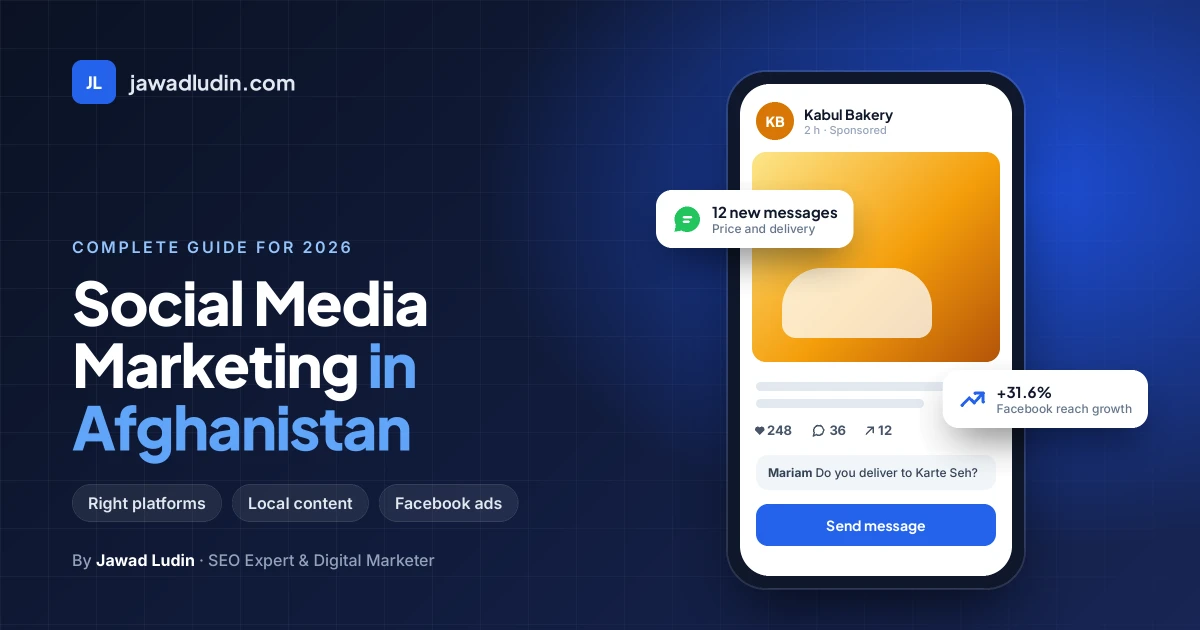
Picture a bakery in Kabul that posts a short video of fresh bread coming out of the oven. By evening, a dozen people have sent a WhatsApp message asking about prices and delivery. Nobody ran a big campaign. The owner simply showed up where customers already spend time.
That is the promise of social media marketing in Afghanistan, and it is more practical than many business owners expect. You don’t need a large budget or a creative agency. You need a clear goal, the right two or three platforms, content in your customers’ language, and a simple way to turn messages into sales.
Short answer
Social media marketing in Afghanistan works best when you start with one measurable goal, focus on Facebook first, add Instagram, WhatsApp and Messenger for conversations, publish light and useful content in Dari, Pashto or English, and track every enquiry. Small, steady, well measured efforts beat big campaigns built on guesswork.
This guide covers the numbers behind the market, a platform by platform comparison, a step by step social media strategy, content ideas for different industries, Facebook ads, measurement, pricing models and a 90 day plan you can start this week.
Social media marketing in Afghanistan: the 2026 numbers
Good decisions start with accurate numbers. According to DataReportal’s Digital 2026 Afghanistan report, Afghanistan had about 11.3 million internet users at the end of 2025 and about 5.00 million active social media user identities. Those identities grew by about 1.2 million (31.6 percent) in a single year, which is fast growth by any standard.
Here is how the main platforms compare, using the advertising reach figures published in each platform’s own planning tools and reported by DataReportal:
| Platform | Reach in late 2025 | Change over the year | Best suited for |
|---|---|---|---|
| About 5.00 million | Up about 31.6 percent | Most consumer businesses, community building, local offers | |
| Messenger | About 2.30 million | Up about 7.0 percent | Customer conversations and quick enquiries |
| About 1.85 million | Up about 54.2 percent | Visual brands: food, fashion, beauty, interiors, events | |
| About 660 thousand members | Up about 15.8 percent | Services sold to companies, recruitment, international clients | |
| X | About 281 thousand | Down about 21.5 percent | News style updates and specific professional audiences |
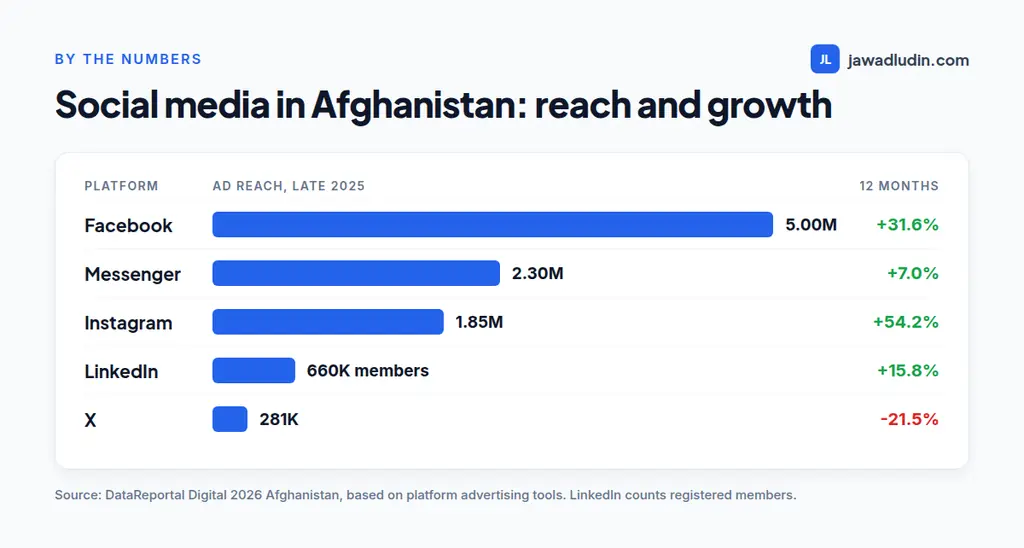
Two notes on reading this table. First, DataReportal points out that Meta has revised how it reports audience data, so use these numbers to understand scale, not as exact head counts. Second, LinkedIn reports registered members rather than monthly active users, so its active audience is smaller than the figure suggests.
Another useful source is Statcounter’s social media statistics for Afghanistan. Its September 2026 data, which measures the share of visits that social platforms send to websites, puts Facebook at about 75 percent, followed by X at about 17 percent, then YouTube and Instagram at about 3 percent each. The two sources measure different things, but they point the same way: Facebook is where the largest audience is.
What these numbers mean for social media marketing in Afghanistan
- Facebook is the natural starting point. Its audience is the largest, and a business page, a Messenger inbox and a handful of well made posts can bring in customers quickly.
- Instagram is the fastest growing option. If your product looks good in a photo or a short video, Instagram marketing deserves a place in your plan.
- The audience is young. UN data cited in the DataReportal report puts the median age in Afghanistan at 17.3, so younger customers are an important part of your future market.
- Precise targeting matters more than size of reach. Facebook’s ad reach equals about 45 percent of the country’s internet users, so the people you want are probably reachable if you describe them precisely.
Why social media marketing works for Afghan businesses
Social media marketing is one of the most effective ways for Afghan businesses to reach new customers, build brand awareness, and increase sales. With the growing use of smartphones and social media platforms such as Facebook, Instagram, TikTok, and YouTube, businesses can connect with their target audience more easily than ever before.
It is also a cost-effective marketing strategy, allowing small businesses and startups to promote their products and services without spending a large amount of money. By sharing engaging content, running targeted advertising campaigns, and communicating directly with customers, Afghan businesses can build trust, strengthen customer relationships, and stand out from competitors.
Whether you own a local shop, an online store, or a service-based company, social media marketing can help you grow your business and reach customers across Afghanistan and beyond.
Choosing the right platform for your business
You don’t need to be everywhere. Good social media marketing in Afghanistan starts with the platforms where your customers already are, then does those well.
Facebook marketing suits almost every consumer business: shops, restaurants, clinics, schools, training centres, service providers and online sellers. Use your page to show products and prices, post customer feedback, announce offers and answer questions in the comments. Join or create groups related to your industry, because group conversations often lead to direct enquiries.
Instagram marketing works best for businesses where the picture sells the product: fashion, jewellery, handmade goods, bakeries, restaurants, interior design, photography and events. Short videos and stories take less effort than polished photo shoots and often perform just as well. A clean bio with a phone number or WhatsApp link turns viewers into buyers.
WhatsApp and Messenger
Many Afghan customers prefer to ask a question in a message rather than fill in a form. Treat WhatsApp and Messenger as your sales counter. The free WhatsApp Business app lets you add a business profile, a catalogue, quick replies and an away message, which keeps a small team consistent. Put a click to chat link on your Facebook page, Instagram bio, website and Google Business Profile.
YouTube
YouTube suits tutorials, product demonstrations, property tours and educational content. Videos stay searchable for years, so one useful how to video can keep bringing customers long after you publish it. Keep videos reasonably short and add captions so viewers can follow without sound.
LinkedIn is the right place for consultancies, software teams, translators, trainers, recruiters and exporters who want to reach companies, development organisations and international clients. A complete company page, regular posts about your work and active personal profiles for your key people will build credibility with buyers abroad.
Other platforms
TikTok, Telegram and others can suit specific audiences and formats, particularly short video. Treat them as experiments once your core channels are running well, and check that your audience genuinely uses them before investing time.
Not sure which platforms fit your business? Jawad Ludin, a digital marketer in Afghanistan, can look at your goals and audience and suggest where to start.
A step by step social media strategy
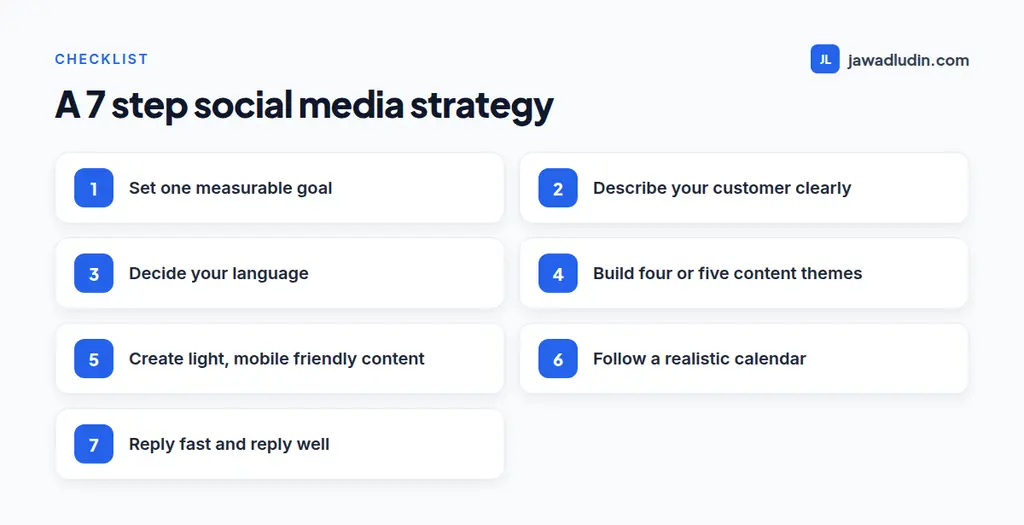
A social media strategy does not need to be long. These seven steps are enough to plan the first three months.
Step 1: Set one measurable goal
“Get more followers” isn’t a business goal. Choose something you can count in the next 90 days: more WhatsApp enquiries, more bookings, more orders, more course applications or more visits to your shop. Every post and ad in your social media strategy should support that single goal.
Step 2: Describe your customer clearly
Write down who you want to reach: where they live, which language they prefer, what they need, what makes them hesitate and how they decide. Ask existing customers how they found you and which apps they use every day. The answers will usually tell you which platform to start with.
Step 3: Decide your language
Write in the language your customers use. Many Afghan businesses reach local customers in Dari or Pashto, and reach international or diaspora customers in English. Some mix languages, and that can work well when it reflects how your customers speak. Whatever you choose, keep each post clear and consistent, and make sure the text reads properly on a phone screen.
Step 4: Build four or five content themes
Themes keep you from staring at a blank screen. A simple set for most businesses:
- Useful tips and answers. Respond to the questions customers ask you every week.
- Products or services in action. Show real work, real products and real results.
- Behind the scenes. Introduce your team and your process, which builds familiarity and trust.
- Customer stories. Share feedback and photos, with the customer’s permission.
- Offers and announcements. Keep these to a small share of your posts so the feed doesn’t feel like one long advertisement.
Step 5: Create light content that works on mobile data
Many people browse on prepaid data, so content that loads quickly gets watched more often. Keep videos short and put the main message in the first few seconds. Add captions. Compress images before uploading. A clear photo with a strong caption often matches the performance of a costly production, and it takes minutes to make.
Step 6: Follow a realistic calendar
Two or three useful posts each week beat a rushed daily post that nobody enjoys making. Plan a month ahead around the moments that matter to your customers: Ramadan, Eid, Nowruz, the start of the school year, wedding season and harvest or market seasons for agricultural products. These moments give you natural reasons to post and a chance to wish your community well in a way that feels genuine.
You can also reuse good material. One helpful article can become several posts, a short video and a WhatsApp status update.
Step 7: Reply fast and reply well
Social media is a conversation. Aim to answer comments and messages within a few hours on working days. Thank people for compliments, answer questions politely and handle concerns calmly and in public when appropriate, then continue privately if details are needed. A quick, friendly reply is often the deciding factor between two competing businesses, and it is the cheapest part of any social media strategy.
Social media content ideas by industry
Use this table as a starting point, then keep the ideas that bring questions and enquiries from your own customers.
| Business type | Content that tends to work |
|---|---|
| Restaurants and bakeries | Short videos of preparation, daily specials, customer photos, delivery information by area |
| Fashion and handmade goods | Lookbooks, size guides, close up photos, behind the scenes of making the product |
| Clinics and health services | Simple health tips from qualified staff, opening hours, introductions to the team |
| Schools, universities and training centres | Course details, admission dates, student success stories, short lessons |
| Online stores | Product demos, delivery times by city, honest descriptions, customer reviews |
| Software, design and consulting firms | Case studies, short tutorials, team profiles, LinkedIn articles for international clients |
| Exporters of saffron, carpets, dried fruit and other goods | Product origin stories, quality and packaging photos, certifications, shipping details |
| NGOs and community organisations | Programme updates, volunteer stories, event announcements, vacancy notices |
Facebook ads and paid social: start small and learn fast
Facebook ads and Instagram ads can bring results quickly, because they put your offer in front of a defined audience. The key is to treat the first month as learning, not as a race.
- Pick one offer and one audience. For Facebook marketing, narrow targeting by city, age range and interests usually beats a broad campaign.
- Choose the objective that matches your goal. If you want conversations, use the messages objective. If you want sales through your website, use the conversion or traffic objectives.
- Test a small budget first. Measure the cost of each enquiry, not just clicks or likes, and increase spending only on Facebook ads that prove themselves.
- Change one thing at a time. Test a new image, a new headline or a new audience separately so you know what made the difference.
- Avoid blind boosting. Boosting a post with no clear objective tends to produce likes from people who will never buy.
- Check payment and policy details first. Payment methods and advertising rules can change by country and currency, so confirm what your ad account accepts before you plan a campaign, and read each platform’s ad policies so your ads are approved smoothly.
If an agency or freelancer runs your Facebook ads, make sure the ad account belongs to your business and that you can see the spending at any time.
How to measure social media results
What you measure decides what you improve. Set up tracking before you launch.
- Platform insights. Facebook and Instagram show reach, engagement, follower growth and message volume for free.
- UTM links. Add tracking parameters to links you share so Google Analytics shows which post or ad sent each visitor. Google’s free Campaign URL Builder makes this simple.
- The Meta pixel. Install it on your website if you run Facebook ads or Instagram ads, so you can see which ads lead to actions.
- An enquiry log. A basic spreadsheet with the date, channel, product and outcome of each enquiry is often the most accurate data a small business can have, because so many sales begin with a call or a WhatsApp message.
Here are the numbers worth reviewing every month:
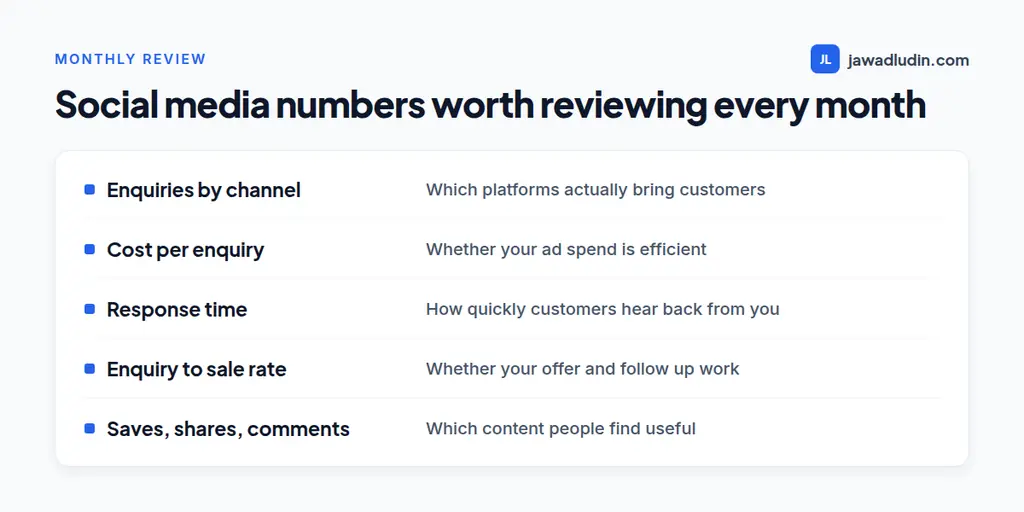
Likes and views are useful signals, but they are not the goal. Compare the numbers with the goal you set in Step 1.
Social media works best as one channel in a wider plan for digital marketing in Afghanistan, where budgets and tracking are shared across search, ads, email and messaging.
Working with creators and local partners
Local personalities and content creators can help a brand reach new audiences, especially when the partnership feels natural. Choose people whose followers match your customers, agree on what will be delivered in writing, and ask them to be open about the collaboration. Smaller creators with an engaged local following often bring better results for a modest budget than a famous name with a broad audience.
Partnerships with complementary businesses work too. A bakery and a catering company, a clinic and a pharmacy, or a training centre and an employer can share each other’s posts and offers to the benefit of both.
Social media and SEO work better together
Social media builds attention and conversation. Search builds long term, steady visibility. When customers see your Facebook page and then search your name on Google, a complete website and Google Business Profile reassure them that you are an established business.
A few simple connections to make:
- Keep your business name, address, phone number and opening hours identical on social pages, your website and Google.
- Link to your best pages from your social profiles, so your audience can find prices, services and contact details easily.
- Turn your most popular social posts into articles on your site, and turn articles into posts.
Your website also needs to appear when customers search for your services. Keyword research in Dari, Pashto and English, fast mobile pages and a complete Google Business Profile are the basics of SEO in Afghanistan.
Should you hire a specialist or do it yourself?
Many first steps can be handled by the owner or a trusted team member: setting a goal, posting regularly, answering messages and collecting reviews. A specialist becomes valuable for social media strategy, paid advertising, tracking and consistent content production, where experience saves time and money.
Social media management is usually priced in one of these ways:
| Model | What you get | Best for |
|---|---|---|
| One time strategy session or audit | A review of your accounts and a prioritised action plan | Teams with in house staff who need direction |
| Monthly management | Content planning, posting, community management and reporting | Businesses that want steady growth |
| Ad campaign management | Setup, testing and optimisation of paid campaigns | Businesses with a clear offer and an ad budget |
| Training for your team | Workshops and templates so staff can run accounts themselves | Organisations that prefer to keep it in house |
Prices vary with the number of platforms, the amount of content and the market you target, so ask for a written scope of work before you commit. Before hiring anyone, ask:
- Can you show examples of your previous work and explain what you did?
- What exactly will you deliver each month?
- Which numbers will you report?
- Who owns the page, ad account and analytics accounts? (The answer should be you.)
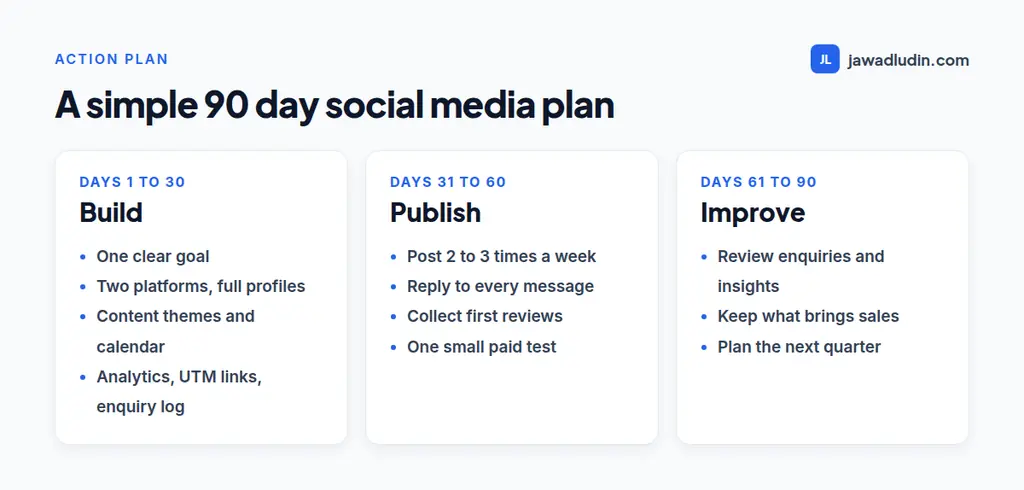
A simple 90 day social media plan
Here is how to turn your social media marketing in Afghanistan into a routine over the next three months.
- Days 1 to 30, build the foundation: set one measurable goal, describe your ideal customer, choose two platforms, complete every profile section with a clear photo, description, contact details and WhatsApp link, create your content themes and a first month calendar, and set up Analytics, UTM links and an enquiry log.
- Days 31 to 60, publish and learn: post two or three times a week, reply to every message quickly, collect your first customer reviews and photos, and start one small paid test if it fits your goal.
- Days 61 to 90, improve and grow: review your enquiry log and platform insights, keep the content that attracts questions and sales, stop what doesn’t, and plan the next quarter with clearer numbers. If it makes sense, add a third platform.
Social media mistakes that slow growth
- Posting without a goal, then judging results by likes.
- Trying to be on every platform instead of doing two well.
- Buying followers or reviews, which damages trust and teaches platforms nothing useful about your real audience.
- Using heavy videos and large images that are slow to load on mobile data.
- Leaving messages unanswered for a day or more.
- Planning around old statistics. Always check the date on any figure you use.
- Relying on social media alone with no website or Google Business Profile that you control.
Conclusion
Social media marketing in Afghanistan rewards businesses that are clear, consistent and helpful. Choose one goal, start with Facebook, add Instagram and WhatsApp where they fit, and share light, honest content in your customers’ language. Reply quickly, measure what brings enquiries, and improve a little every month.
The audience is growing, trust is built through simple habits any owner can practise, and the tools are free or low cost. Start with the 90 day plan above, and let your results show you where to invest next.
Need help with social media marketing? Work with Jawad Ludin
I am Jawad Ludin, a Digital Marketing Manager and SEO Strategist with more than four years of hands on experience in SEO and Google Ads. I plan and run social media marketing that is tied to your business goals: platform choice, content planning, Meta ads and tracking, set up so you can see which posts and ads bring enquiries. No inflated promises, just a clear plan and steady work.
Tell me about your business and your goals, and I will tell you where I would start. You can also see my experience.
Frequently asked questions about social media marketing in Afghanistan
Which social media platform is best for business in Afghanistan?
Facebook has the largest audience by advertising reach, so it is the best first platform for most consumer businesses. Add Instagram if your products are visual, WhatsApp and Messenger for customer conversations, and LinkedIn if you sell to companies or international clients.
How much does social media marketing cost in Afghanistan?
There is no single price. A business can begin with free organic posting and a small test ad budget, then grow spending as results come in. If you hire help, the cost depends on how many platforms, how much content and how much ad management you need, so ask for a written scope and a clear list of deliverables.
How often should I post?
Two or three useful posts a week is a realistic target for most small businesses. Consistency matters more than volume, and replying to comments and messages matters as much as posting.
Should I post in Dari, Pashto or English?
Use the language your customers use. Local consumer businesses often get the best response in Dari or Pashto, while businesses serving international clients usually need English. You can offer more than one, as long as each post is clear and easy to read.
How long before social media brings results?
Early signals such as more messages and saves can appear within the first few weeks. Steady enquiries and sales usually take two to three months of consistent posting, replying and improving. Judge progress over weeks, not days.