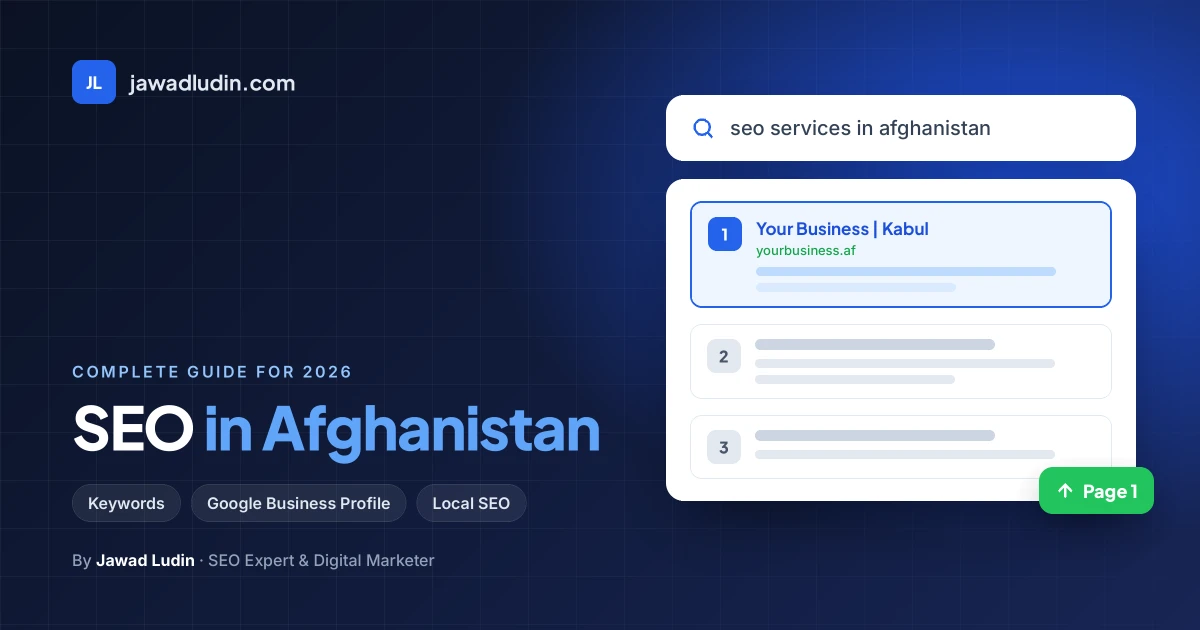
Picture a customer in Kabul who needs a solar inverter, a dentist or an accountant. They take out their phone, type a few words into Google and, within seconds, choose two or three businesses to call. Most never scroll past the first results. If your business is not there, that customer goes to a competitor without ever knowing you exist.
That is what SEO in Afghanistan is about: making sure your business is one of the names people see when they search. In many Afghan industries the competition on Google is still weak, so a business that gets the basics right can stand out faster than it could in a crowded market.
Short answer
SEO in Afghanistan means making your website and your Google Business Profile easy for Google to find, understand and trust. In practice it comes down to five things: a fast website that works well on a phone, a clear page for each service, content in the language your customers search in, a complete Google Business Profile, and honest measurement of the enquiries search brings you.
This guide explains each step in practical terms, with the conditions that make Afghanistan different from the markets most SEO advice is written for: slow mobile connections, searches in Dari, Pashto and English, and customers who would rather call or send a WhatsApp message than fill in a form. It also covers what SEO services include, how pricing works and how to choose the right help.
What SEO in Afghanistan looks like in 2026
A few numbers shape almost every decision in this guide.
- Google dominates search. According to Statcounter, Google handled about 96% of search engine traffic in Afghanistan in June 2026. For most businesses, SEO simply means Google SEO.
- Most visits come from phones. Statcounter’s data also shows that mobile devices accounted for roughly 78% of web traffic in the same month.
- The online audience is growing. DataReportal’s Digital 2026 Afghanistan report estimates 11.3 million internet users in October 2025, about 25.5% of the population, up by roughly 725 thousand in a year.
- Connections are slow. The same report cites Ookla data showing a median fixed internet download speed of 4.47 Mbps at the end of 2025.
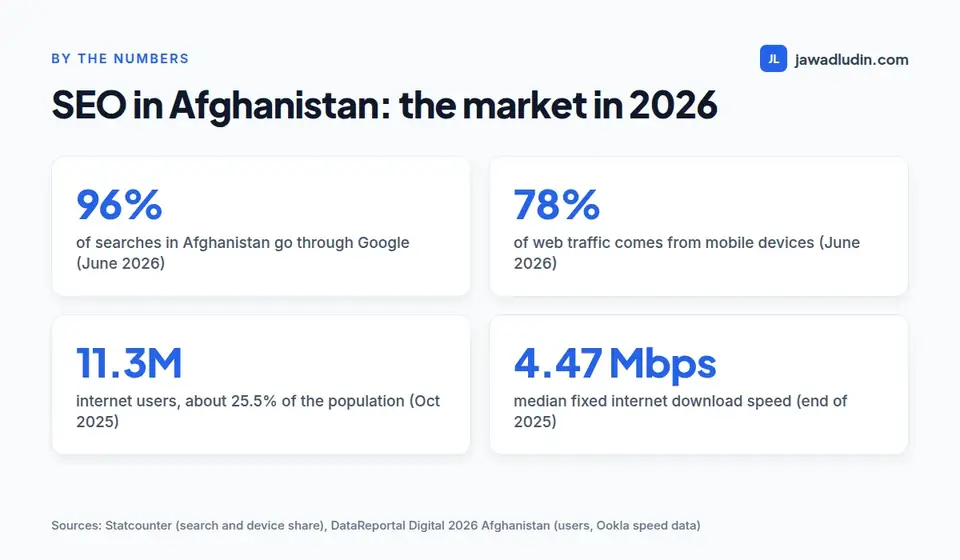
Put together, this tells you what to prioritise. Your customers are searching on Google, on a phone, often on a slow connection. A heavy website that looks impressive on an office computer can fail exactly the people you want to reach.
What makes the Afghan market different
- Dari pages compete with websites from Iran. Dari and Iranian Persian are written in the same script and are largely treated as one language, Persian, by search engines. A Dari page about mobile phone prices therefore competes with a huge number of Iranian pages. Afghan vocabulary, Afghan city names, prices in afghani and a local phone number help both Google and visitors see that your page is meant for Afghanistan.
- Pashto content is scarce. There is far less Pashto content online than English or Persian, so a genuinely useful Pashto page often faces little competition.
- People mix scripts and languages. Many users type Dari or Pashto words in Latin letters, and switch to English for product names and technical terms.
- Calls and WhatsApp beat contact forms. Most enquiries arrive as phone calls or WhatsApp messages, so a visible phone number and a WhatsApp button matter more than a long form.
- Every megabyte costs your visitor money. Many people browse on prepaid mobile data, so a light website is both a courtesy to them and an advantage in search.
Why SEO matters for Afghan businesses
Paid advertising stops the moment your budget runs out. Visibility you earn through SEO keeps bringing visitors for as long as your pages stay useful and your site stays healthy. For a small business with a limited budget, that makes SEO one of the most cost effective long term channels available.
SEO also builds trust. A customer who finds your business on Google, sees a complete Google Business Profile with real photos and reviews, and lands on a clear website is far more likely to call you than one who only sees a social media page. For businesses that sell to clients abroad, such as software, design, translation or consulting, Google is often the first place an international buyer checks whether you are real.
What SEO services include
SEO is not one task. It is a set of jobs that support each other, and a good plan uses the ones your business actually needs.
| Type of SEO | What it covers | Who needs it most |
|---|---|---|
| Technical SEO | Speed, mobile usability, indexing, sitemaps, redirects, HTTPS and site structure | Every website, especially older or slow sites |
| On page SEO | Titles, headings, meta descriptions, internal links and content on each page | Every website |
| Local SEO | Google Business Profile, reviews, map results and consistent contact details | Shops, clinics, restaurants and any business with local customers |
| Content SEO | Service pages, guides and answers to customer questions | Businesses in competitive markets and anyone building trust |
| Multilingual SEO | Separate Dari, Pashto and English pages, hreflang and right to left layout | Organisations serving more than one language group |
| Link building and digital PR | Earning mentions and links from trusted websites | Businesses competing for national or international searches |
| AI search optimisation | Clear facts, structured data and mentions that AI answers can use | Businesses that want to appear in Google AI Overviews and AI assistants |
For most small businesses, the biggest early gains come from technical fixes, strong service pages and a complete Google Business Profile. Link building and large content projects usually come later, once the foundation is solid.
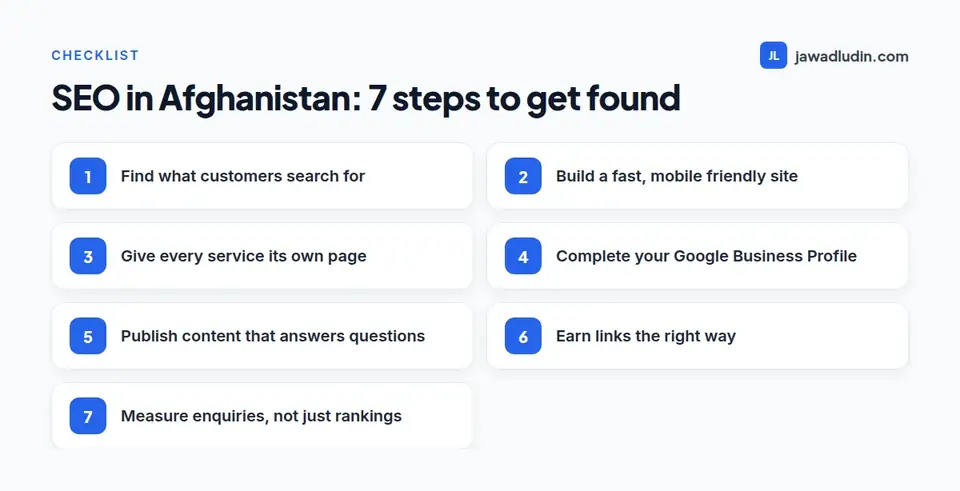
Step 1: Find what your customers actually search for
Good SEO starts with the words real customers type into Google. Guessing is one of the most common reasons a business website gets little search traffic: the site describes the business in the owner’s words, while customers search in completely different ones.
Simple ways to find keywords without paid tools
- Write down every service you offer and the questions customers ask you on the phone or on WhatsApp every week. These questions are often your best keywords.
- Type your main service into Google and note the autocomplete suggestions, the “People also ask” box and the related searches at the bottom of the page. Do the same in Google Maps, where many local searches start.
- Search with and without a city name, for example “solar panels” and “solar panels Kabul”, and see how the results change. If a map appears, the search has local intent and your Google Business Profile matters.
- Once your site is live, use the Performance report in Google Search Console to see which searches already show your pages. This is real data about your own audience.
Plan for Dari, Pashto and English searches
The same service can be searched in three languages and several spellings, including Dari or Pashto words typed in Latin letters. Ask your customers which words they would use, then check each version in Google to see what kind of pages rank. If the results for a Dari search are mostly Iranian websites, a page written clearly for Afghan customers has a real chance to stand out.
Group keywords by intent
Someone searching “how to choose a solar inverter” is still learning. Someone searching “solar inverter price Kabul” is close to buying. These two people need different pages: a helpful guide for the first, and a clear product or service page with prices or a contact option for the second. Grouping keywords this way also stops several of your pages from competing for the same search.
Step 2: Build a fast website that works on slow connections
Google uses the mobile version of your pages for indexing and ranking, which it calls mobile first indexing. If important content is missing or broken on your mobile site, it effectively does not exist for Google. With most Afghan traffic on phones and connections as slow as they are, speed decides whether visitors stay.
- Compress images before uploading them and use modern formats such as WebP. A single uncompressed photo from a phone camera can be several megabytes.
- Avoid heavy extras such as autoplay background videos, large sliders and many custom fonts. They add weight for very little value.
- Use caching and reliable hosting. A caching plugin and a host with a content delivery network help pages load quickly in Afghanistan and abroad. Your server does not need to be inside the country.
- Keep pages readable on small screens with clear text, buttons that are easy to tap, and no pop ups that cover the content.
- Test with free tools such as Google PageSpeed Insights and fix the biggest issues first.
A simple test: open your website on a mid range phone using mobile data, not office WiFi. If you would lose patience waiting for it, your customers will too.
Step 3: Give every important service its own page
A single “Services” page that lists everything in a few lines rarely ranks for anything. Google needs a page that clearly matches a search. If you offer accounting, tax filing and payroll, each one deserves a dedicated page that is the best answer for that topic.
What a strong service page includes
- A title tag and an H1 that include the main keyword naturally, for example “Tax Filing Services in Kabul”.
- A meta description that explains the benefit and gives people a reason to click.
- Useful detail: what the service includes, who it is for, how the process works, typical timelines and what affects the price.
- Answers to the questions customers really ask, in plain language.
- A clear way to get in touch: phone number, WhatsApp button and a short contact form.
- Links from your home page and related pages, so visitors and Google can find it.
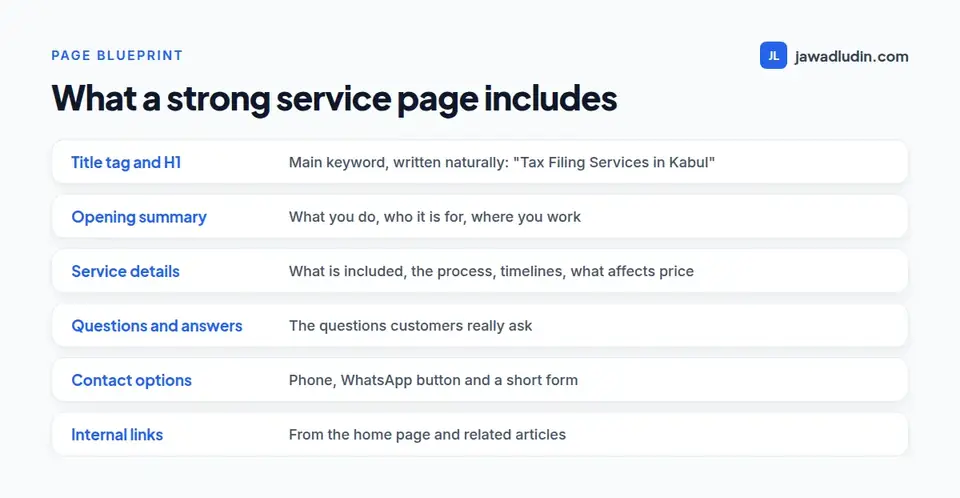
A well-structured page for SEO services follows this pattern, with each type of work explained separately.
Language versions done properly
If you publish in more than one language, give each language its own page instead of mixing Dari and English side by side. Google detects language from the visible text, so one language per page is the clean approach. Then connect the versions with hreflang tags, so Google shows the Dari page to Dari searchers and the English page to everyone else. In the HTML of each version, it looks like this:
<link rel="alternate" hreflang="fa-AF" href="https://example.af/fa/services/" />
<link rel="alternate" hreflang="ps-AF" href="https://example.af/ps/services/" />
<link rel="alternate" hreflang="en" href="https://example.af/en/services/" />
<link rel="alternate" hreflang="x-default" href="https://example.af/en/services/" />
Adding the region code AF to the Dari and Pashto versions tells Google they are written for Afghanistan, which helps separate them from Iranian Persian pages. Dari and Pashto also read from right to left, so check that menus, forms and numbers display correctly, and that the language label in each page’s HTML matches its language. Every translation should be written for people, not produced by a quick machine translation that no one has checked.
Help Google understand your business with structured data
Structured data, also called schema markup, is code that states facts about your business in a format machines can read: your name, logo, address, phone number, opening hours and the services you offer. For a local business, LocalBusiness or Organization markup is the place to start, and most SEO plugins for WordPress can add it without any coding. It makes your details easier for Google and AI tools to read, and it supports the information on your Google Business Profile.
Step 4: Complete your Google Business Profile
For searches with local intent, such as a service plus a city name, Google often shows a map with business listings above the normal results. Those listings come from Google Business Profile, which is free. For a local business, it is often the fastest win available.
Google says local results are mainly based on relevance, distance and prominence. You cannot change your distance from a customer, but you can influence the other two:
- Choose the most accurate primary category, because it tells Google what your business actually is.
- Add your website, phone number, opening hours and a clear description of what you do.
- Upload real photos of your premises, team and work instead of stock images.
- Keep your business name, address and phone number exactly the same on your website, your profile and every directory.
- Ask satisfied customers for honest reviews and reply to every review, positive or negative.
- Use posts and updates to share offers, news and new services.
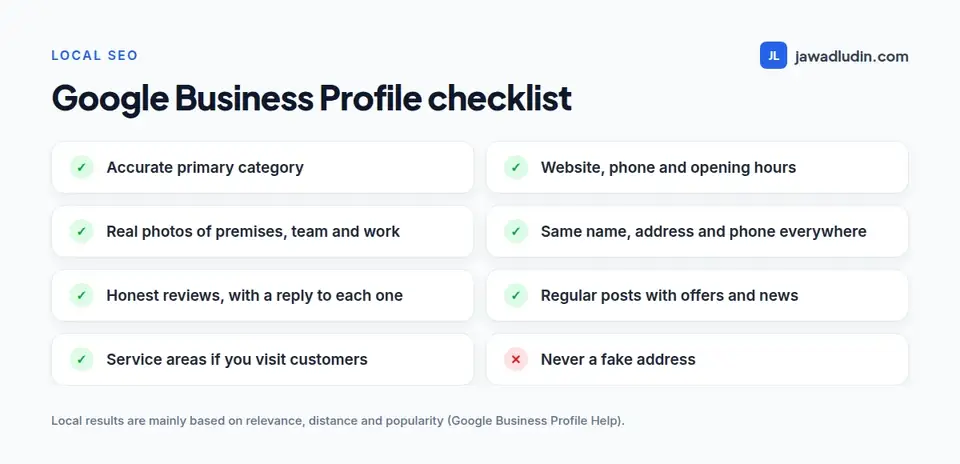
Verification and service areas
Before your profile appears on Google, you must verify that you run the business. Google chooses the method, which can be a phone call, a text message, an email or a short video. For a video, you show the business sign or location, the equipment or stock you work with, and proof that you manage the business. Have these ready before you start.
If you work from home or visit customers at their location, set up a service area business. You still need a real, verifiable address, but you can hide it and list the areas you serve instead. Never invent an office address to appear in a better location. It breaks Google’s guidelines and can get your profile suspended.
Want an expert to check your website and Google Business Profile? Jawad Ludin, an SEO expert in Afghanistan, can review your setup and show you what to fix first.
Step 5: Create content that answers real questions
Content is how your website proves you know your field. Google’s own guidance asks whether content provides original information, shows real expertise and leaves the reader feeling they learned enough to reach their goal.
In Afghanistan, the biggest content opportunity is local relevance. Generic articles copied from international websites do not explain local prices, local rules, local suppliers or local customer habits. You can. Some content ideas that work in many industries:
- “How much does it cost to…” guides that explain what affects the price in your city.
- Comparison guides, such as two materials, two service options or two common products.
- Step by step guides for processes customers find confusing.
- Answers to the ten questions customers ask you most often.
- Explanations of the kind of problems you solve, without sharing private client details.
Link each article to the service page it relates to. This moves readers from helpful content to the page where they can contact you, and helps Google understand which page matters most for that topic.
Step 6: Earn links and mentions the right way
Links from reputable websites are still one of the ways Google judges whether a site is trustworthy and well known. They are also where shortcuts cause the most damage. Google’s spam policies treat buying or selling links for ranking purposes as link spam, whether you pay with money, goods or services.
Safe link building ideas in Afghanistan
- Get listed in reputable business directories, chambers of commerce and industry associations you actually belong to.
- Ask partners, suppliers and clients to mention you on their websites where it is natural, for example on a “where to buy” or “our partners” page.
- Share expert comments and useful data with local and diaspora media.
- Sponsor or speak at events, training programs and university activities, which often link to participants.
- Publish genuinely useful resources, such as a price guide or a checklist, that others want to reference.
Avoid packages that promise hundreds of links for a small fee. Those links usually come from low quality networks and can lead to a manual action that removes your site from Google.
Step 7: Measure your progress
Set up measurement before you start, so you can see which changes actually work.
- Google Search Console shows impressions, clicks, average position and the searches that bring people to your site. Submit your XML sitemap there and check the Pages report for indexing problems.
- Google Analytics shows what visitors do on your site. Track phone clicks, WhatsApp clicks and form submissions as events.
- Your own records matter just as much. Ask every new customer how they found you and write down the answer.
Rankings on their own do not pay salaries. The real goal is enquiries and sales, so review those numbers every month.
How to appear in Google AI Overviews and ChatGPT answers
More searches now end with an AI answer, either in Google AI Overviews or in assistants such as ChatGPT, Gemini and Perplexity. Google explains in its guide to AI features and your website that the same SEO best practices apply: there is no special markup or trick required, and a page must be indexed and eligible to appear in normal results first.
This works in favour of Afghan businesses, because AI tools have very little reliable local information to draw on. A business that publishes clear, accurate facts gives them something to quote:
- Answer questions directly. Start sections with a plain one or two sentence answer, then add detail.
- Keep your facts consistent. Your business name, services, cities, opening hours and contact details should match on your website, Google Business Profile and social profiles.
- Add structured data for your organisation, local business, articles and products.
- Earn mentions on trusted sites. AI answers lean on sources that other websites already cite, such as news coverage, associations and directories.
- Publish what only you know: local prices, processes and real examples. Generic text is easy for AI to replace; first hand knowledge is not.
SEO priorities by type of organisation
The basics are the same for everyone, but the priorities change with your audience.
- Local service businesses such as clinics, workshops, restaurants and shops: Google Business Profile, reviews and one strong page per service and city. Most customers search for something near them in Kabul, Herat, Mazar, Kandahar or Jalalabad.
- NGOs and development organisations: English pages for donors and partners, Dari and Pashto pages for the people you serve, and clear pages for programs, reports and vacancies, which are often the most searched content.
- Universities, schools and training centres: one page per program with admission dates, fees and requirements. Students search for these details every intake season.
- Banks, fintech and insurance: Google holds financial topics to a higher standard, so accurate information, named experts, clear policies and secure, fast pages matter even more.
- Exporters of saffron, carpets, dried fruit, marble and other goods: English content written for international buyers, with product specifications, certifications and shipping details.
- Online stores: unique product descriptions, delivery information by city and fast category pages that work on a phone.
Planning for internet disruptions
One factor most SEO guides never mention: in late September 2025, a nationwide shutdown cut internet access across Afghanistan for about two days. Disruptions like this can affect your visitors, your ability to update your site and your customers’ ability to reach you.
- Host your website with a reliable provider, so it stays online for international visitors even when local access is disrupted.
- Keep your phone number visible on your website and Google Business Profile, because calls may still work when data does not.
- Keep backups of your website and content in cloud storage.
- Do not panic if Search Console shows a sudden drop during a disruption. Check the dates before changing anything on your site.
How much does SEO cost in Afghanistan?
There is no standard price, because the work depends on your website, your market and your goals. What you can compare is how the work is priced and what is included:
| Pricing model | What you get | Best for |
|---|---|---|
| One time SEO audit | A full review of your website with a prioritised list of fixes | Businesses that want a clear plan or have an in house team |
| Monthly retainer | Ongoing technical work, content, local SEO and reporting every month | Businesses that want steady growth over 6 to 12 months |
| Project fee | A defined job such as a new website launch, a migration or a multilingual setup | One off changes with a clear end point |
| Hourly consulting | Advice and training for your own staff | Teams that want to do the work themselves |
The price goes up or down with the size and condition of your website, the number of languages and cities you target, how competitive your keywords are and how much new content you need. Be careful with very cheap monthly packages. They often consist of automated reports and bought links, which can harm your site. A fair offer always comes with a written list of tasks, the numbers that will be reported and who owns the accounts. As a reference point, the published SEO service cost in Afghanistan currently ranges from about $99 to $799 a month, depending on scope.
Want to know what SEO would cost for your business? Every website and market is different, so there is no single fixed price. Share your website and your goals, and you will receive a clear quote with the exact tasks included. Contact me for an SEO quote.
How long does SEO take?
SEO is a long term channel, and knowing what to expect helps you judge whether it is working. A typical timeline for a small or medium business:
- Month 1: audit, keyword research, Search Console and Analytics setup, technical fixes and a complete Google Business Profile.
- Months 2 to 3: new and improved service pages, first helpful articles, internal links and the first reviews. Pages start to appear for less competitive searches.
- Months 4 to 6: more content, steady link and mention building, and improvements based on Search Console data. Enquiries from search usually become measurable in this period.
- Months 6 to 12: growth on more competitive keywords, as older pages gain authority.
In markets with little competition, results can come sooner. In crowded markets, or for a brand new domain, they can take longer. Judge progress by impressions, clicks and enquiries, not by a single ranking on one day.
How to choose an SEO expert in Afghanistan
Google’s page Do you need an SEO? is worth reading before you hire anyone. It says a good SEO should give you realistic estimates of improvement and of the work involved, and states plainly that no one can guarantee a number one ranking on Google.
Questions to ask any SEO provider before you hire them:
- Can you show examples of your previous work and explain what you did?
- What exactly will you do in the first three months?
- How will you report progress, and which numbers will you track?
- Will you build links, and if so, how?
- Will I keep full ownership of my website, Google Business Profile, Search Console and Analytics accounts?
The last question matters more than it seems. Your accounts should always belong to your business, with the specialist added as a user. It also helps to know the options:
| Option | Strengths | Watch out for |
|---|---|---|
| Doing it yourself | Lowest cost, you know your business best | Takes time to learn; technical problems are easy to miss |
| Freelance SEO expert | Direct contact with the person doing the work, flexible and usually affordable | Check real examples and how much time they can give you |
| Local agency | A team covering design, content and ads together | Make sure an experienced specialist, not a junior, handles your SEO |
| International agency | Large teams and tools | Higher prices and often little knowledge of Dari, Pashto or local search habits |
Common SEO mistakes to avoid
- Copying content from other websites, including competitors abroad.
- Repeating the same keyword unnaturally in every sentence.
- Building pages as images or heavy animations that Google cannot read.
- Leaving the website untouched for months while competitors keep improving.
- Using a fake address or fake reviews on Google Business Profile.
- Buying links, or trusting anyone who guarantees first place.
Conclusion
SEO in Afghanistan rewards businesses that get the basics right and keep improving. Your customers search on Google, mostly on a phone and often on a slow connection, in Dari, Pashto or English. The businesses that win are the ones with a fast website, a clear page for every service, content in their customers’ language, a complete Google Business Profile and honest measurement of the enquiries search brings in.
None of this happens overnight. Expect the first results in a few months and steady growth over a year, and be wary of anyone who promises instant or guaranteed rankings. Start with the foundation, publish useful content regularly and judge progress by enquiries, not by a single ranking. SEO also works best as part of a wider plan for digital marketing in Afghanistan, alongside ads, social media and messaging.
If you would rather have an expert handle it, Jawad Ludin, the best SEO expert in Afghanistan for businesses that want honest, long term growth, can review your website and build a clear plan for you.
Looking for the best SEO expert in Afghanistan? Work with Jawad Ludin
I am Jawad Ludin, a Digital Marketing Manager and SEO Strategist with more than four years of hands on experience in SEO and Google Ads. I help businesses get found on Google through keyword research, technical SEO, on page and off page optimisation, local SEO and content strategy. No ranking guarantees, just a clear plan and steady work.
Tell me about your website and your goals, and I will tell you where I would start. You can also read more about me.
Frequently asked questions about SEO in Afghanistan
Do I need a .af domain to rank in Afghanistan?
No. A country domain such as .af is a strong signal to Google that your site targets Afghanistan, which can help in local results. A .com domain also works well when your content, language and contact details clearly show that you serve Afghan customers. If you sell mainly to clients abroad, a .com is usually the better choice.
Can I do SEO myself?
Yes. Many steps in this guide, such as setting up your Google Business Profile, writing service pages and answering customer questions, can be done by the business owner. Expert help becomes useful for technical problems, competitive markets, and when you need a clear plan and consistent execution.
Should my website be in English, Dari or Pashto?
Use the language your customers search in. Local consumer businesses often need Dari and Pashto. Businesses selling to international clients usually need English. If you need more than one, create a separate page for each language and connect them with hreflang tags.
Can anyone guarantee first page rankings on Google?
No. Google itself says no one can guarantee a number one ranking, and it advises businesses to avoid anyone who promises it. A trustworthy specialist explains what they will do, how progress will be measured and what a realistic timeline looks like.
Does SEO help my business appear in AI answers?
Yes. Google AI Overviews and most AI assistants draw on pages that already rank well and on sources that are mentioned often. Clear answers, consistent business details, structured data and trusted mentions help both normal rankings and AI visibility.