A plumber pays for a new website, posts on Facebook three times a week and runs a few Google ads. Six months later the phone rings about as often as it did before. Nothing he did was wrong on its own. He just never decided who he wanted to reach, what he wanted them to do, or how he would know if it worked.
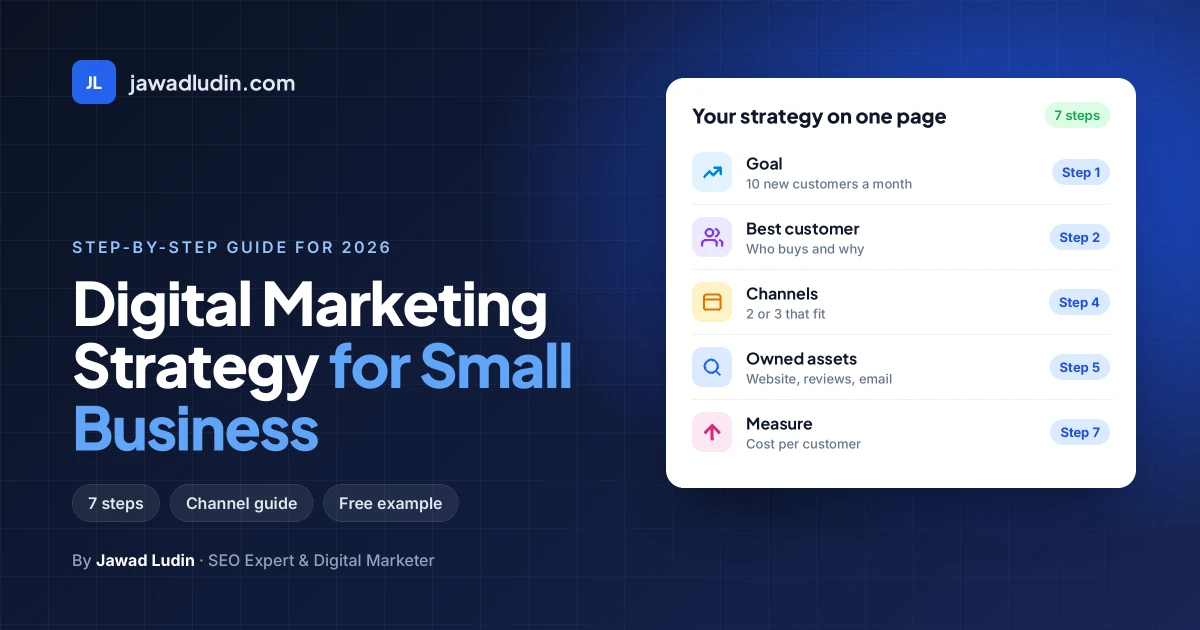
That is what a digital marketing strategy for small business fixes. It is a short set of decisions about your goal, your customer, your offer and your channels, made before you spend time or money. This guide walks through those decisions in seven steps, with a channel guide by business type, simple maths for setting targets, and a one-page example you can copy.
Short answer
A digital marketing strategy for small business starts with one measurable goal, a clear picture of your best customer and a reason to choose you. Pick two or three channels that match how your customers buy, build on assets you own (your website, Google Business Profile, reviews and an email list), set a test budget, and track cost per lead and cost per customer. Review every 90 days and keep what works.
What a digital marketing strategy is (and how it differs from a plan)
A digital marketing strategy is the set of choices: who you serve, what you promise them, which channels you will use and how you will measure success. A plan is the schedule that puts those choices into action, with tasks, dates, owners and a budget. The Australian Government’s business.gov.au describes a marketing plan as the document that helps you “define the strategy, activities and channels to promote your products or services”. In other words, the strategy comes first and the plan carries it out.
| Strategy | Plan | |
|---|---|---|
| Answers | Who, what, why and where | What happens when, who does it and what it costs |
| Time frame | 12 months or more | 90 days to 12 months |
| Changes | Rarely, when the business changes | Often, as results come in |
| Example | “We win local families who want a reliable plumber within 2 hours” | “Publish 8 Google Business Profile posts and ask every customer for a review in Q1” |
Get the digital marketing strategy right first. Once it is clear, you can turn it into a dated digital marketing plan in an afternoon.
Why small businesses need a digital marketing strategy, not more tactics
Your customers are already online. According to DataReportal’s Digital 2026 Global Overview Report, more than 6 billion people now use the internet, and more than 1 billion use AI tools every month. The question is not whether to market online, but where and how much.
Small businesses rarely fail at digital marketing because they pick the wrong tool. They fail because they try everything at once, measure nothing and stop before anything has time to work. A strategy forces three useful limits: one goal at a time, a few channels instead of ten, and numbers you check every month.
It also protects the assets that keep working when you stop paying. Reviews are a good example: in BrightLocal’s 2026 Local Consumer Review Survey, 97% of consumers said they read reviews for local businesses and 41% said they always do. An ad stops working the day the budget runs out. A strong review profile keeps selling for years.
Step 1: Pick one business goal and work backwards
“Get more followers” is not a business goal. “Win 10 new customers a month from online channels by June” is. Start with the result that pays your bills, then work backwards to the activity you need.
Here is the maths with example numbers. Replace them with your own as soon as you have real data.
| Question | Example answer | Result |
|---|---|---|
| How many new customers do you want each month? | 10 | Goal: 10 customers |
| What share of enquiries become customers? | 25% (1 in 4) | 10 / 0.25 = 40 enquiries |
| What share of website visitors send an enquiry? | 2% | 40 / 0.02 = 2,000 visits |
| Where will 2,000 visits a month come from? | Search, Google Business Profile, social, email | Your channel mix |
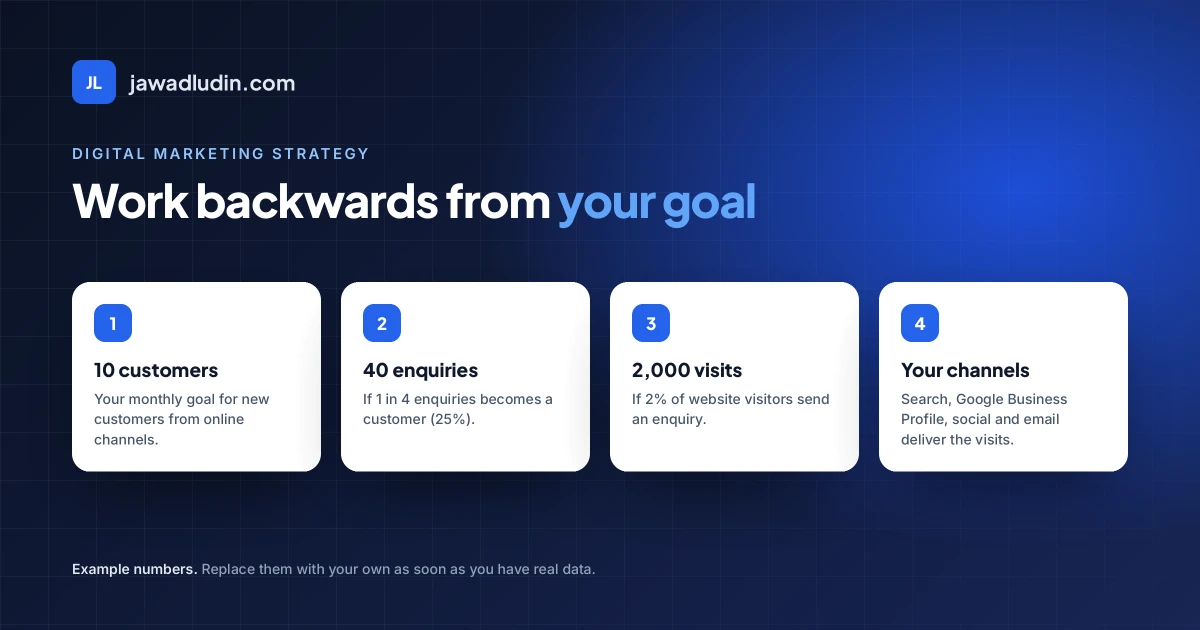
This exercise changes decisions quickly. If 2,000 visits is unrealistic, you can improve the 2% conversion rate (a clearer page, a faster reply, a better offer) instead of chasing more traffic. Often that is the cheaper fix.
Step 2: Describe your best customer in one paragraph
You do not need a ten-page persona. You need one paragraph that a new employee could read and understand who you are trying to win. Answer these questions about the customers who already pay you well and come back:
- Who are they (type of person or business, location, budget)?
- What problem makes them start looking for a business like yours?
- What do they type into Google, or ask friends and AI assistants, when that happens?
- What makes them hesitate before buying?
- Where do they spend time online: Google, Facebook, Instagram, LinkedIn, TikTok or WhatsApp?
For example: “Homeowners within 15 km who have a leak or a broken boiler, search Google on their phone for an emergency plumber, compare reviews, and call the first business that answers and gives a clear price.”
Step 3: Decide why a customer should choose you
Most small business websites say the same things: quality, experience, great service. None of these helps a customer choose. Your digital marketing strategy needs one specific reason, written as a sentence you can repeat in every channel:
We help [your best customer] get [the result they want] without [the frustration they fear], because [your proof].
For example: “We help busy homeowners get a leak fixed the same day without surprise bills, because every job has a fixed price agreed before we start.” That sentence tells you what to put in your ads, your Google Business Profile description and your review requests.
Step 4: Choose channels by how your customers buy
There is no best channel for every small business. The right mix depends on whether people search for you when they have a problem, discover you while scrolling, or research you for weeks before buying. Use this table as a starting point:
| Business type | Start with | Add next | Usually wait on |
|---|---|---|---|
| Local service (plumber, clinic, salon) | Google Business Profile, reviews, a fast website | Local SEO, Google Ads for urgent searches | TikTok, influencer campaigns |
| Restaurant, cafe or shop | Google Business Profile, Instagram or Facebook, reviews | Email or WhatsApp offers for regulars | Long-form blog content |
| Online store | Product pages that rank, email marketing, Meta ads | Google Shopping, short-form video | Broad brand awareness ads |
| B2B or professional services | Website with service pages, LinkedIn, SEO content | Email newsletter, case studies | Instagram and TikTok |
| Coach, creator or course seller | One social platform, email list, a lead magnet | YouTube or podcast guest spots | Paid search |
Two or three channels done well beat seven done badly. If social media is one of yours, compare the best social media marketing tools before you pick a scheduler, because the cheapest option often covers everything a small business needs.
Not sure which channels fit your business? Tell me about your customers and goals, and I will suggest where to start.
Step 5: Build on assets you own
Social platforms change their rules and ad prices rise. The parts of your marketing you own keep their value. Make these the centre of your digital marketing strategy and send every channel back to them:
- Your website. Fast on mobile, one page per service, a clear phone number or form on every page.
- Google Business Profile. Complete, with real photos, correct hours and regular updates. Google says local results are mainly based on relevance, distance and popularity, and reviews feed into popularity.
- Reviews. Ask every happy customer, reply to every review, and never buy them.
- An email list. The one audience you can reach without paying a platform. If you are new to it, start with this guide to email marketing for beginners.
These four assets also help with AI search. When someone asks ChatGPT or Google for a recommendation, the answer is built from what the web says about you: your own pages, your profile and your reviews.
Step 6: Set a money budget and a time budget
There is no single right number. As a reference point, Gartner’s 2025 CMO Spend Survey found that larger companies spent 7.7% of revenue on marketing, and half of the leaders surveyed had budgets of 6% of revenue or less. A small business usually starts lower and more cautiously.
A practical approach is to set a fixed monthly test budget you can afford for 90 days without stress, then split it with a simple rule of thumb many marketers use: about 70% on what already works, 20% on promising channels and 10% on experiments. In your first quarter, “what works” may simply be your website and Google Business Profile.
Time matters as much as money. Be honest about the hours you have:
| Hours per week | What a realistic strategy looks like |
|---|---|
| 2 to 3 | Google Business Profile updates, review requests, one social channel, one email a month |
| 5 to 8 | The above, plus one helpful website article a month and a small, tracked ad test |
| 10 or more | A full content calendar, two social channels, a weekly or fortnightly email and ongoing ads |
Tools do not need to be expensive either. Most small businesses can run the whole strategy on cheap digital marketing tools with free plans, and save hours each week with simple marketing automation for small business.
Step 7: Measure the few numbers that matter
Likes and impressions are easy to collect and easy to misread. Track the numbers that connect marketing to money, and check them monthly. Free tools such as Google Analytics 4 and Search Console cover most of this, and you can see how they fit with the other best digital marketing tools for small businesses:
| Metric | What it tells you | How to get it |
|---|---|---|
| Enquiries (calls, forms, messages) | Whether marketing creates demand | Call tracking, form notifications, a simple enquiry log |
| Cost per lead | What each enquiry costs you | Marketing spend divided by enquiries |
| Cost per customer | What each new customer costs you | Marketing spend divided by new customers |
| Customer lifetime value | How much you can afford to spend to win a customer | Average sale x purchases per year x years they stay |
| Source of each customer | Which channel to keep or cut | Ask “How did you find us?” and use tagged links |
A quick example of why lifetime value matters: if an average sale is $80, a customer buys 3 times a year and stays 2 years, that customer is worth $480 in revenue. Spending $40 to win them can be a good deal, even if the first sale alone looks unprofitable.
Make your digital marketing strategy work for AI search too
More people now ask AI assistants for recommendations. BrightLocal’s 2026 survey found that Google, Facebook and AI tools like ChatGPT are the most common places consumers look for local recommendations. The good news is that you do not need a separate AI strategy. Google states that there are no additional requirements to appear in AI Overviews or AI Mode beyond normal SEO best practices.
Start with the basics in Google’s own SEO Starter Guide, then use a few of the best SEO tools to see which questions people search for. These habits help most:
- Answer the questions customers ask, clearly and near the top of the page.
- Keep your name, address, phone number and services the same everywhere they appear.
- Earn reviews that mention the specific service and location.
- Publish real details: prices or price ranges, service areas, opening hours and how the process works.
Digital marketing strategy for small business: examples by goal
The same seven steps lead to very different strategies depending on the goal. Here are three common ones.
Goal: more calls and visits for a local business
Focus on being found at the moment of need. Complete your Google Business Profile, build a page for each service and each area you cover, and make review requests part of every job. Add Google Ads only for urgent, high-value searches, and track calls from each source separately.
Goal: more online sales for a small store
Focus on product pages and repeat buyers. Write product pages that answer real questions, collect email addresses with a useful first-order offer, and send a welcome series and a simple abandoned cart email. Use paid social to test new products, and judge it on cost per sale, not on clicks.
Goal: more leads for a B2B or professional service
Focus on trust and proof. Publish service pages and case studies, share practical advice on LinkedIn, and invite readers to a newsletter. Sales cycles are longer, so measure qualified enquiries and meetings booked rather than website traffic.
A one-page digital marketing strategy example
Here is how the seven steps fit on one page, using a fictional local physiotherapy clinic as the example:
| Part | Example |
|---|---|
| Goal | 15 new patients a month from online channels within 6 months |
| Best customer | Adults within 10 km with back, neck or sports injuries who want an appointment this week |
| Why us | Same-week appointments and a written recovery plan after the first visit |
| Channels | Google Business Profile and reviews, a service page for each treatment, a monthly email to past patients |
| Owned assets | Website, Google Business Profile, review profile, patient email list |
| Budget | Fixed monthly test budget for 90 days, plus 4 hours a week of staff time |
| Key numbers | Bookings, cost per booking, source of each booking, review count and rating |
| Review | Every 90 days: keep, fix or drop each channel |
When your page looks like this, your digital marketing strategy for small business is finished. The next step is a dated plan of tasks.
Common digital marketing strategy mistakes
- Copying a big brand’s strategy when you have a fraction of their budget and time.
- Choosing channels because they are popular rather than because your customers use them to buy.
- Sending all traffic to a home page instead of a page built for that offer.
- Judging results after two weeks. Most channels need at least 90 days of steady work.
- Measuring likes instead of enquiries and customers.
- Relying on one platform you do not control for all of your leads.
Should you do it yourself or hire help?
Many owners can run a simple digital marketing strategy themselves, especially in the first year. Doing it yourself works when you have a few hours every week, enjoy writing or filming content, and your goal relies mainly on Google Business Profile, reviews, one social channel and email.
Bring in a specialist when the stakes or the complexity go up: paid ads with a real budget, technical SEO, tracking across several channels, or growth targets that need consistent weekly work. A good specialist should start by asking about your goal, your customers and your numbers, not by selling you a package.
Conclusion
A good digital marketing strategy for a small business fits on one page: one goal, one clear customer, one reason to choose you, two or three channels, a budget you can sustain and a handful of numbers you check every month. Make those decisions first, then build the plan, and review everything every 90 days.
Frequently Asked Questions
What is the best digital marketing strategy for a small business?
The best strategy starts with one measurable goal and two or three channels your customers already use. For most local businesses that means a strong Google Business Profile, reviews, a fast website and an email list, with paid ads added once tracking is in place.
How much should a small business spend on digital marketing?
There is no fixed rule. Gartner found that larger companies spent 7.7% of revenue on marketing in 2025. Most small businesses start with a fixed monthly test budget they can sustain for 90 days, then increase spending on the channels that bring customers.
What is the difference between a marketing strategy and a marketing plan?
The strategy is the set of choices about who you target, why they should buy and which channels you use. The plan turns those choices into dated tasks, owners and a budget.
How long does digital marketing take to work for a small business?
Paid ads can bring enquiries within days. SEO, content and reviews usually take three to six months to show steady results. Review your strategy every 90 days rather than every week.
Can I do digital marketing myself as a small business owner?
Yes. With two to three hours a week you can manage your Google Business Profile, reviews, one social channel and a monthly email. Bring in help when you want to scale paid ads or SEO.