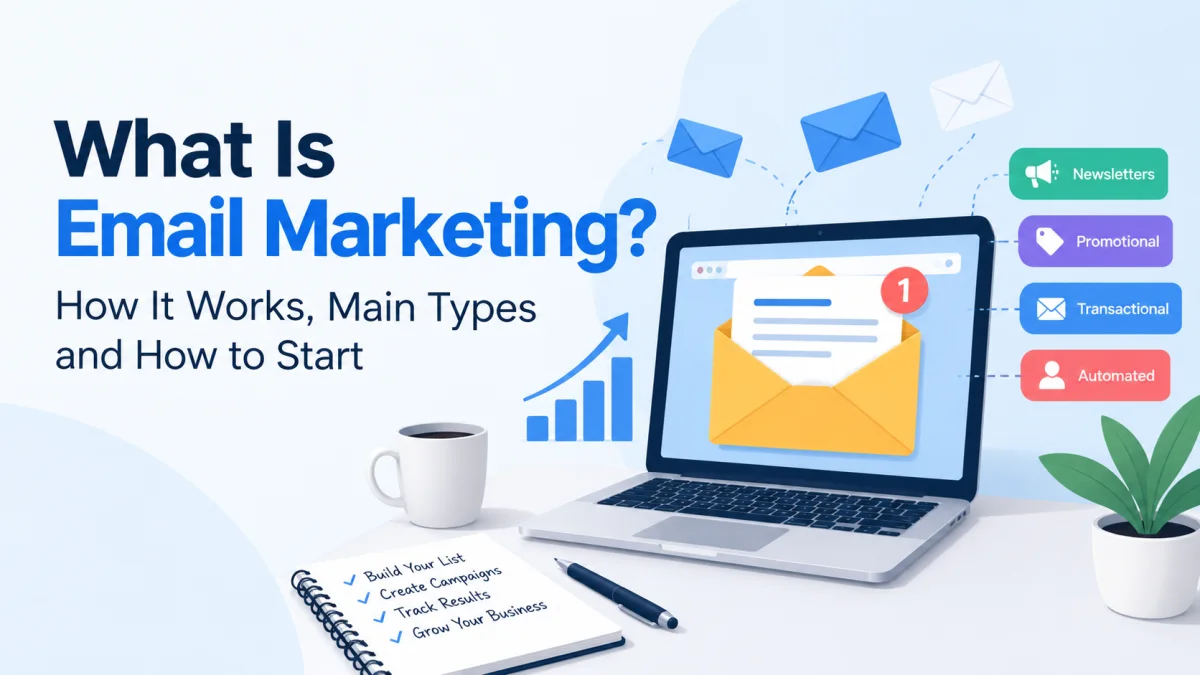
Email marketing is the practice of sending commercial messages (offers, newsletters, product updates, order notices) by email to people who have agreed to receive them. The aim is usually to build a relationship that leads to a first sale, a repeat purchase, or a reader who keeps coming back to your site.
That’s the short answer. The rest of this guide covers how it works in practice, the types of emails businesses send, the legal rules and inbox requirements that catch people out, and a realistic way to start when you have no list and no budget yet.
What is email marketing?
Email marketing is a form of direct, permission-based digital marketing. You collect addresses from people who choose to subscribe, then send them messages that promote products or services, share useful content, or support them after they buy.
Three things separate it from spam: permission, relevance and an easy way out. Subscribers opted in, the message is something they’d plausibly want, and every email lets them leave in a click or two. If any of those three is missing, you’re not doing email marketing, you’re just sending email.
The reason businesses keep investing in it comes down to ownership. On social platforms, an algorithm decides who sees your post. With email, your list is a database you control, and a message lands in a person’s inbox rather than competing in a public feed. You still depend on inbox providers to deliver your messages (more on that below), but the relationship itself belongs to you, not to a platform.
A very short history
Email itself dates back to 1971. The first commercial email followed in 1978, when a marketer at Digital Equipment Corporation sent a product announcement to a few hundred people on ARPANET. For decades after that, email marketing meant blasting one message to as many addresses as possible. Privacy and anti-spam laws changed the model, and modern email marketing is built on consent, segmentation and personalisation instead.
How email marketing works
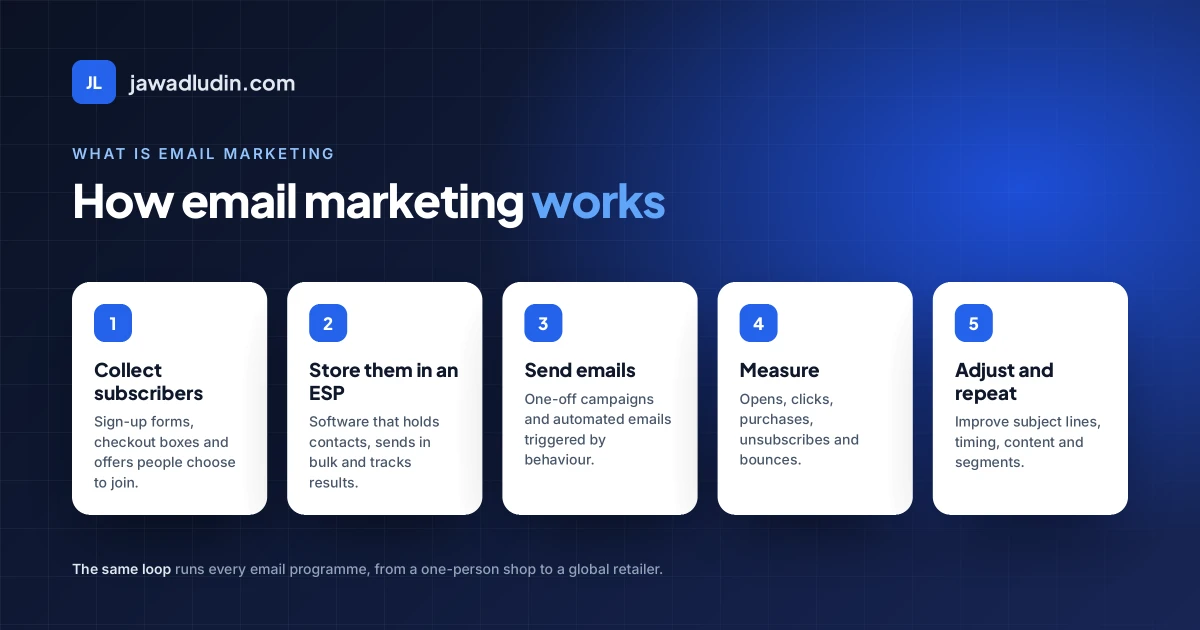
Every email programme, from a one-person shop to a global retailer, runs on the same basic loop:
- Collect subscribers. People join your list through a sign-up form, a checkout box, a downloadable guide or a discount offer.
- Store them in an email service provider (ESP). This is the software that holds your contacts, sends your emails in bulk and tracks what happens afterwards.
- Send messages. These are either one-off campaigns (a sale announcement, a newsletter) or automated emails triggered by behaviour (a welcome series, a basket reminder).
- Measure the results. Opens, clicks, purchases, unsubscribes and bounces tell you what’s working.
- Adjust. You change subject lines, timing, content or segments, and run the loop again.
Why not just use a normal Gmail or Outlook account? Because personal mailboxes aren’t built for bulk sending. They cap volume, they offer no unsubscribe handling or analytics, and mass mail from them is easy for spam filters to flag. A proper ESP handles the technical authentication and legal plumbing for you.
The main types of marketing emails
Most email programmes use a mix of the following. The right mix depends on what your business sells and where your customers are in their journey.
| Type | What it’s for | Typical example |
|---|---|---|
| Welcome email | Introduce your brand and set expectations | A thank-you plus what the subscriber will receive and how often |
| Newsletter | Stay in regular contact with useful content | Monthly roundup of articles, news or tips |
| Promotional email | Drive a sale or sign-up | A seasonal offer with a clear deadline |
| Lead nurturing sequence | Move an interested prospect towards a decision | Three or four emails after someone downloads a guide |
| Abandoned basket email | Recover a purchase that stalled | A reminder showing the items left behind |
| Re-engagement email | Win back inactive subscribers | “Still want to hear from us?” with a clear yes or no |
| Transactional email | Confirm or support an action | Order confirmation, shipping update, password reset |
| Survey or review request | Collect feedback | A short question a few days after delivery |
One distinction is worth knowing early. Transactional emails (receipts, delivery notices, password resets) are triggered by something the customer did, and people expect them. They’re not really “marketing”, but they’re read far more reliably than promotions, so many businesses add a helpful, relevant line or two to them. In the US, the Federal Trade Commission treats messages whose main purpose is transactional as exempt from most of its commercial email rules, though they still can’t carry false or misleading routing information. Add too much promotion, and the message may count as commercial after all.
Why businesses still use email marketing
It’s reasonable to wonder whether a channel this old still earns its place. The evidence says it does, with some caveats about how the numbers are collected.
Return on investment. In Litmus’s 2025 State of Email survey of nearly 500 marketing professionals, 35% of respondents reported earning between $10 and $36 for every $1 spent on email. Treat figures like this as self-reported and industry-dependent; plenty of small senders earn less, especially in the first months. The same survey found that around a fifth of marketing leaders don’t measure email ROI at all, which says something about how loosely these numbers get used.
Low cost of entry. Many providers offer free tiers with limits on contacts or monthly sends, so you can test the channel before paying. Check current terms, because free plans change often.
Personalisation at scale. Because you know who subscribed and what they’ve done on your site, you can send different messages to different groups. A first-time visitor and a customer who bought twice last month shouldn’t get the same email.
Measurability. You can see who opened, who clicked and who bought, which makes it easier to learn quickly than with most offline channels.
Fit with everything else you do. Email works well alongside search, social and paid ads. A reader who finds you through Google can be invited to subscribe, and an email can bring that reader back to new content later. Search brings new readers in, the best SEO tools show which pages attract them, and email keeps those readers coming back.
Email versus social media
Social media is excellent for discovery. People who’ve never heard of you can stumble across a post and follow you. But reach on any platform can shrink without warning, and you can’t contact your followers outside the app. Email is slower to build and less glamorous, yet it gives you a direct line to people who have already said yes. Most healthy marketing plans use social to attract attention and email to keep it. The right social media marketing tools make the social side of that pairing much easier to run.
The downsides to plan for
Email marketing isn’t free money, and it helps to know where it goes wrong.
- Deliverability. A message that lands in spam does nothing. Inbox providers judge you on sender reputation, engagement, list quality and technical setup, not just the wording of your email.
- Crowded inboxes. Your email competes with dozens of others. Open and click rates drift down for everyone, so relevance matters more than volume.
- List decay. Addresses go stale as people change jobs, abandon accounts or lose interest. A bigger list isn’t automatically a better one.
- Cost growth. Most providers charge by contacts or by sends, so bills rise as you grow. Cleaning out inactive subscribers helps.
- Time. Good emails need a clear goal, decent copy and some testing. Automation saves effort once it’s set up, but the setup takes thought.
The rules: consent, unsubscribes and the law
Laws differ by country, and nothing here is legal advice, but the principles are consistent enough to follow as a baseline.
| Region | Core rule for marketing email |
|---|---|
| UK | Under the Privacy and Electronic Communications Regulations (PECR) and UK GDPR, you generally need consent to email individuals, or must meet every condition of the “soft opt-in” for existing customers, and you must always offer a way to opt out. |
| EU | GDPR requires a lawful basis, usually consent, plus clear information on how data is used and an easy way to withdraw. |
| US | The CAN-SPAM Act doesn’t require prior consent, but demands accurate sender information, a valid postal address, a clear opt-out, and that you honour opt-outs within 10 business days. |
A few specifics worth knowing. The UK soft opt-in only works when you collected the person’s details yourself during a sale or negotiation of a sale, you’re promoting similar products or services, and you gave them a clear chance to opt out when you collected the details and in every message since. It doesn’t cover bought-in lists. In the US, the FTC says in its CAN-SPAM compliance guide for business that the Act applies to business-to-business email as well as consumer email, and that each non-compliant message can carry a penalty of up to $53,088. And hiring an agency or platform doesn’t transfer your legal responsibility.
The practical takeaway is the same everywhere: don’t buy lists, keep a record of how and when each person subscribed, make unsubscribing painless, and be honest about who you are.
Getting into the inbox: authentication basics
Even a fully consented list can end up in spam if your sending setup looks suspicious. Since early 2024, Google has required more from large senders. According to Google’s email sender guidelines, all senders should authenticate with SPF or DKIM, while senders of more than 5,000 messages a day to Gmail users need SPF, DKIM and DMARC, plus one-click unsubscribe on marketing and subscribed messages. Google also applies a spam-complaint threshold to bulk senders.
In plain terms:
- SPF tells receiving servers which systems are allowed to send mail for your domain.
- DKIM adds a digital signature proving a message wasn’t altered and really came from you.
- DMARC tells receivers what to do when a message fails those checks, and sends you reports.
Most reputable ESPs walk you through these records during setup. If you send under 5,000 a day you may not formally count as a bulk sender, but setting all three up is still sensible, because it protects your domain from being spoofed and helps your reputation.
How to start email marketing in seven steps
You don’t need a big budget. You need a goal, a list and a habit.
- Pick one goal. For a first campaign, choose something measurable: sell a specific product, get downloads of a guide, or bring readers back to new articles.
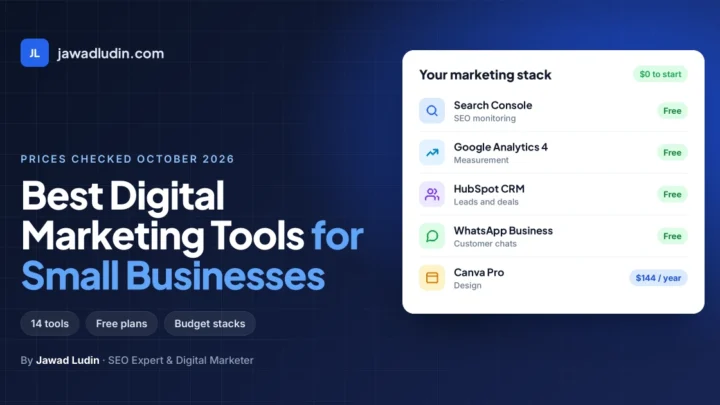
- Choose an email service provider. Compare price per contact or per send, the quality of the template editor, automation features, and whether the platform helps with authentication and unsubscribes. For a side-by-side look at options by budget, see this roundup of digital marketing tools for small businesses.
- Set up your sending domain. Add the SPF, DKIM and DMARC records your provider gives you before sending anything.
- Build your list the honest way. Put a sign-up form on your site, at checkout and at the end of your best content. Offer a reason to join: a useful guide, early access, a first-order discount. Say what subscribers will get and how often. Consider double opt-in, where people confirm by clicking a link, which keeps out typos and fake addresses.
- Write and design a simple email. One clear message, one main call to action, readable on a phone. Plain, well-structured emails often beat elaborate designs.
- Send, then test. Try different subject lines and send times on small groups before rolling changes out to everyone.
- Review results and repeat. Look at clicks and conversions, not only opens, and decide what to change next time.
If you’re deciding where email fits among your other channels and how much to spend on each, plan channels, budgets and measurement together rather than one at a time.
A simple welcome sequence you can copy
Here’s an example for a small online shop. It’s a pattern to adapt, not a formula.
- Email 1, sent straight away. Thank the subscriber, deliver whatever you promised at sign-up, and explain what they’ll receive and how often.
- Email 2, about two days later. Share something useful: a buying guide, a care tip, or your three most popular products with a sentence on why people like them.
- Email 3, about a week after sign-up. Introduce a gentle offer or a clear next step, such as a first-order discount that expires in a few days.
Notice that the first two emails give before the third asks. Subscribers who’ve been helped are more receptive when the sales message arrives.
Which metrics to watch
Your ESP will show a wall of numbers. These are the ones worth paying attention to:
- Click-through rate: the share of recipients who clicked a link. It’s a better signal of interest than opens.
- Conversion rate: the share who completed the action you wanted, such as a purchase or sign-up.
- Unsubscribe rate: a steady climb suggests your frequency or relevance is off.
- Bounce rate: hard bounces (invalid addresses) should be removed promptly; soft bounces (full inboxes) are temporary.
- Spam complaints: keep these very low, because they damage your sender reputation fastest.
- Revenue per email or per subscriber: the number that ties email back to the business.
Open rate deserves a warning. Since Apple introduced Mail Privacy Protection, some mail apps pre-load images, which can record an open even when nobody read the message. Opens are still useful for comparing subject lines against each other, but don’t treat them as proof of attention.
Common mistakes to avoid
- Buying or scraping lists. It breaks consent rules in most places and wrecks deliverability.
- Sending the same email to everyone. Even basic segmentation, such as new subscribers versus customers, improves relevance.
- Hiding the unsubscribe link. It backfires: people hit the spam button instead, which hurts you more.
- Too many calls to action. One main action per email keeps readers focused.
- Ignoring mobile. Many people read email on their phones, so tiny text and wide layouts lose readers.
- Never cleaning the list. Removing people who haven’t engaged in many months protects your reputation and your costs.
- Copying competitors’ tactics without checking they suit your audience. Test before you commit.
Frequently Asked Questions
What is email marketing in simple words?
It’s sending promotional and helpful emails to people who signed up to hear from you, in order to build relationships and encourage sales or repeat visits.
Is email marketing still effective?
Yes, for most businesses that do it properly. It works best when the list is built with permission, messages are relevant, and results are measured. Reported returns vary widely by industry and by how mature a programme is.
Is email marketing the same as spam?
No. Spam is unsolicited. Email marketing is sent to people who opted in, includes accurate sender details and gives them an easy way to unsubscribe.
Do I need an email marketing platform?
For anything beyond a handful of contacts, yes. Platforms manage consent records, unsubscribes, authentication, templates and reporting, which are hard to handle safely from an ordinary mailbox.
How often should I send marketing emails?
It depends on your audience and content. A weekly or fortnightly schedule is a common starting point for newsletters, with automated emails added for specific events. Watch unsubscribe and complaint rates; if they rise after you increase frequency, ease off.
Can I do email marketing for free?
You can start free with a provider’s free tier, within its limits on contacts and sends. As your list grows you’ll probably move to a paid plan.
What’s the difference between email marketing and marketing automation?
Email marketing is the channel. Marketing automation is software that triggers messages based on behaviour or schedules, and it often covers other channels such as SMS as well as email. Email is usually the first thing people automate.
Conclusion
Email marketing is a simple trade: people give you permission, and you send them something worth reading. Build your list legally, authenticate your domain and measure what matters, and email can become one of your most dependable channels.
If you’d like help fitting email into a wider plan alongside search, ads and content, take a look at these digital marketing services.
1 comment