A shop owner opens a Facebook page, posts every day for a month, pays to boost a few posts and gets plenty of likes. Then they look at the sales book and nothing has changed. If that sounds familiar, you are not alone, and the problem is rarely effort. It is almost always the lack of a plan.
Digital marketing in Afghanistan can bring real customers, but only when every post, ad and message works toward a clear goal. This guide shows how to build that plan for the Afghan market, using current data and practical steps you can start this week.
Short answer
Digital marketing in Afghanistan works best when you start from one clear business goal, choose the two or three channels your customers really use, send every enquiry to your website or WhatsApp, and measure every campaign. Facebook has the largest social media reach, Google handles almost all searches, and most web traffic comes from phones. Small, tracked tests beat big campaigns built on guesswork.
Digital marketing in Afghanistan: what the data says
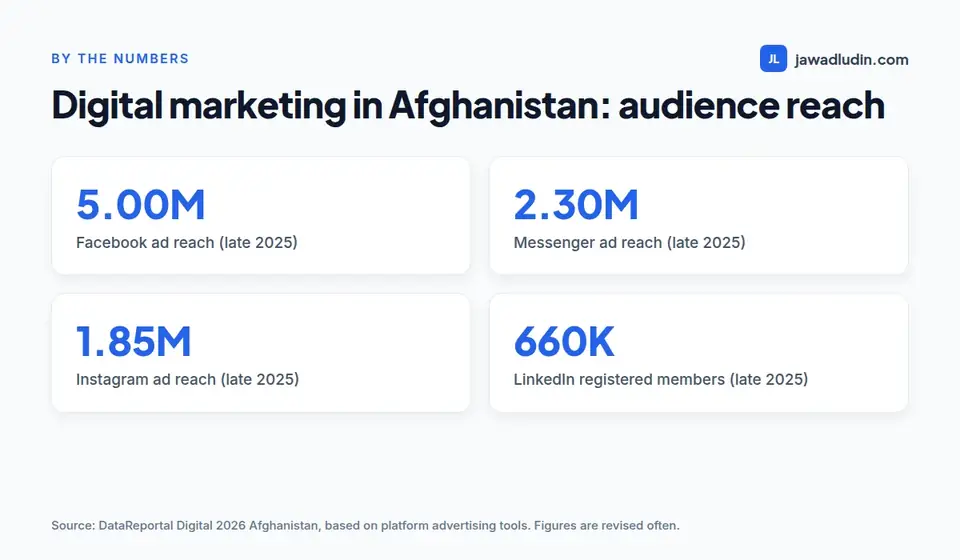
Good marketing decisions start with an honest picture of the audience. These figures come from DataReportal’s Digital 2026 Afghanistan report, produced by Kepios, and from Statcounter.
- Internet users: about 11.3 million in October 2025, or 25.5% of the population. Roughly three in four people were still offline.
- Social media: about 5.00 million active social media user identities, equal to 11.3% of the population.
- Facebook: Meta’s advertising tools showed an ad reach of about 5.00 million in late 2025.
- Messenger and Instagram: an ad reach of about 2.30 million and 1.85 million.
- LinkedIn: about 660 thousand registered members. LinkedIn counts members rather than active users, so the active audience is smaller.
- Search and devices: Google handled about 96% of searches in June 2026, and about 78% of web traffic came from mobile devices.
Two cautions. DataReportal notes that Meta has made meaningful revisions to its audience data, so treat platform figures as a guide to scale, not exact counts. And some articles that rank for this topic still quote internet figures from 2019, so always check the date of a statistic before you plan around it.
What these numbers mean for digital marketing in Afghanistan
- Your online audience is real but limited, so targeting matters more than reach. A campaign aimed at “everyone in Afghanistan” wastes money.
- Facebook has the largest reach, so it is the natural starting point for most consumer businesses, while Instagram, Messenger and LinkedIn matter for specific audiences.
- Everything you build must work well on a phone, on a slow connection.
- Word of mouth and phone calls still reach the large part of the population that is offline. Digital marketing should support them, not replace them.
Step 1: Start with one measurable business goal
Every digital marketing strategy starts with a goal, and “get more followers” is not a business goal. Decide what you want digital marketing to achieve in the next three months, and write it in a form you can measure:
- More phone calls or WhatsApp messages from potential customers.
- More contact form enquiries or booking requests.
- More online orders, or more visits to your shop.
- More applications for a course or a job opening.
- Awareness of a new product, branch or service.
Pick one primary goal. Every channel, post and ad in the plan should support it, and when results come in, this goal is how you judge them.
Step 2: Define who you are trying to reach
Describe your best customers in plain language: where they live, which language they prefer, what they need, what makes them hesitate and how they decide. Then find out where they spend time online. The most reliable research is free:
- Ask existing customers how they found you and which apps they use every day.
- Look at competitors’ pages and notice which posts get real comments and questions, not just likes.
- Read the comments under popular local pages in your industry to learn the words people use.
- Check Google’s autocomplete and “People also ask” results for your main service.
Local customers and international clients need different plans
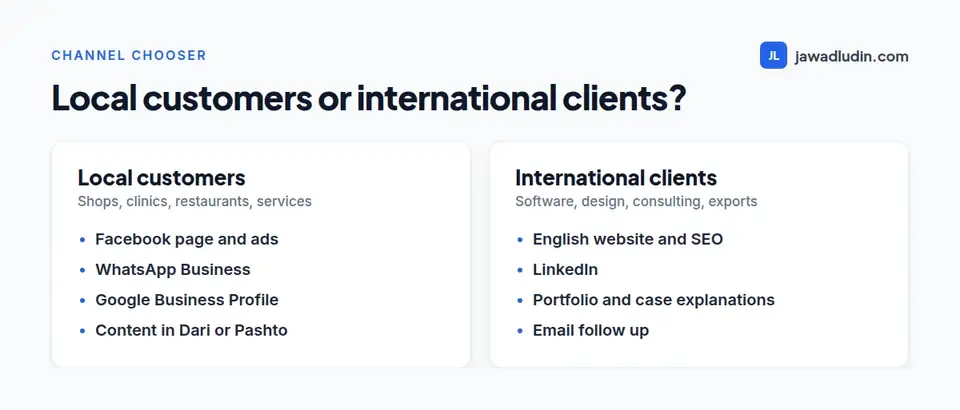
A restaurant in Herat and a software team selling to clients in Europe are both Afghan businesses, but digital marketing in Afghanistan looks completely different for each of them. Local consumer businesses usually focus on Facebook, WhatsApp, Google Business Profile and content in Dari or Pashto. Businesses serving international or diaspora clients usually need an English website, LinkedIn, search visibility outside Afghanistan and clear proof of their work. Decide which group you serve first, because it changes almost every choice that follows.
Step 3: Choose the right digital marketing channels
Successful digital marketing in Afghanistan does not need every platform. Start with two or three channels you can manage well. Here is how the main options compare in practice.
Your website and SEO
Social media platforms change their rules and their reach all the time, and you do not own your followers. Your website is the one place you fully control, and it is where Google sends people who search for what you offer. Good SEO in Afghanistan makes that site easier to find, so it keeps bringing enquiries when social reach drops.
Facebook and Instagram
For most consumer businesses, Facebook is the largest social media audience available, both organic and paid. Use it to show your products, your work and your team, to answer questions and to run targeted Facebook ads. Instagram suits visual businesses such as fashion, food, interior design and beauty, especially when the audience is younger or urban.
WhatsApp and Messenger
For many customers, sending a message is easier than filling in a form. Put a WhatsApp click to chat button on your website, add it to your Facebook page and your Google Business Profile, and reply quickly. The free WhatsApp Business app adds a business profile, quick replies and an away message, which helps a small team respond consistently.
LinkedIn suits business services, recruitment, training providers, consultancies and anyone selling to companies or international organisations. It is rarely the right first channel for a local shop, but it can be the most valuable one for a business that sells expertise.
Google Search and Google Business Profile
When people already know what they need, they search. Showing up at that moment, through SEO, a complete Google Business Profile or search ads, catches demand that already exists instead of trying to create it.
Email works well for staying in touch with existing customers, partners and international clients. You own your email list in a way you never own a social media audience.
Step 4: Make your website and WhatsApp the centre of the plan
Every channel should lead to a place where people can act: a fast page that matches the offer, and a direct way to contact you. When an ad promotes a specific service, send people to the page about that service, not your home page. When a post invites questions, make sure someone answers the WhatsApp number in it.
A quick checklist before you spend any money:
- Does the landing page load quickly on a phone with mobile data?
- Is the offer on the page the same as the offer in the ad or post?
- Can a visitor call or message you with one tap?
- Is someone responsible for replying within a few hours on working days?
- Can you tell which channel each enquiry came from?
Not sure which channels fit your business? Jawad Ludin, a digital marketer in Afghanistan, can look at your goals and audience and suggest where to start.
Step 5: Plan content in the languages your customers use
For digital marketing in Afghanistan, write in the language your customers prefer, whether that is Dari, Pashto, English or a mix. Content with local examples, local prices and familiar situations feels more trustworthy than generic material translated from elsewhere.
Content that works on slow connections
Videos and images catch attention, but heavy files cost viewers on limited data. Keep videos short, put the main message in the first few seconds, add captions so the video works without sound, and compress images before posting. A clear photo with a strong caption often performs as well as an expensive production.
A realistic social media calendar
- Two or three useful posts each week beat a rushed daily post.
- Mix formats: answers to common questions, behind the scenes photos, offers and short tips.
- Plan a month ahead around the moments that matter to your customers, such as Ramadan, Eid, Nowruz and the start of the school year.
- Reuse good material: one blog article can become several posts, a short video and a WhatsApp status update.
Step 6: Use paid ads carefully
Paid ads, including Facebook ads and Google Ads, can bring results quickly, but they also spend money quickly. A few rules protect your budget:
- Start with one clear offer and one well defined audience.
- Spend a small test budget first, then look at the cost per enquiry, not just clicks or likes.
- Change one thing at a time, such as the image, headline or audience, so you know what made the difference.
- Stop what does not work and move the budget to what does.
- Read each platform’s advertising policies before you create the ad, so it is not rejected.
Before planning any campaign, check which payment methods your ad account accepts for your billing country and currency, because these options can change. If an agency or freelancer runs ads for you, make sure the ad account belongs to your business and that you can see the spending at any time.
Avoid boosting posts with no objective. A boosted post with broad targeting often produces likes from people who will never buy. Use the campaign objective that matches your goal, such as messages, leads or website traffic.
Step 7: Track what matters
Measurement is what turns digital marketing in Afghanistan from guesswork into a plan. Set it up before you launch:
- Google Analytics on your website, with events for form submissions, phone clicks and WhatsApp clicks.
- The Meta pixel on your website if you run Facebook or Instagram ads.
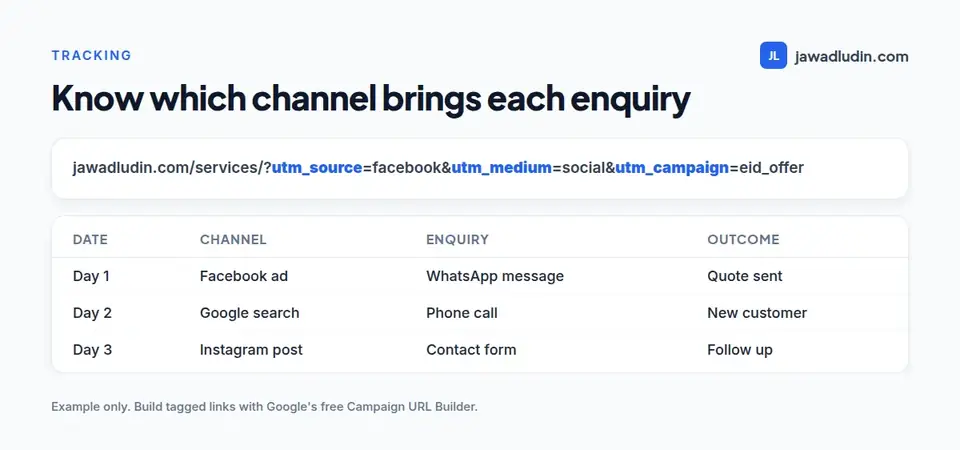
- UTM parameters on the links you share in posts, emails and ads, so Analytics shows which one brought each visitor. Google’s free Campaign URL Builder creates them in seconds.
- A simple enquiry log, even a spreadsheet, recording the date, channel and outcome of every enquiry. If many customers call or message instead of filling in forms, this log is often your most accurate data.
Review the numbers once a month and compare them with your goal. Likes and views are useful signals, but they are not the goal.
Step 8: Plan for internet disruptions
Any plan for digital marketing in Afghanistan must accept that internet access is not always stable. In late September 2025, a nationwide shutdown cut connectivity across the country for about two days. A resilient plan accepts that this can happen:
- Keep a phone number on every channel, because calls and SMS may work when data does not.
- Pause or reduce paid campaigns that target Afghanistan during a disruption, so you do not pay for an audience that cannot reach you.
- Keep copies of your content, customer contacts and ad assets outside a single platform.
- If you serve international clients, tell them in advance how you will communicate if local access is interrupted.
Step 9: Build trust before you ask for the sale
Many customers are cautious about businesses they find on social media or search, especially before paying in advance. Trust often turns a click into an enquiry, and most of it comes from simple, consistent habits:
- Show real photos of your premises, team and work instead of stock images.
- Keep your business name, address, phone number and opening hours identical on your website, Facebook page and Google Business Profile.
- Ask satisfied customers for honest reviews, and reply politely to every review, including critical ones.
- Explain your prices, or at least what affects them, so people know what to expect.
- Reply to messages quickly. A slow reply often sends the customer to a competitor who answered first.
- Publish useful content that shows you understand the customer’s problem, not only posts about your company.
None of these steps costs much, but together they make every social media post and ad more effective, because people who click find a business that looks real, active and easy to deal with.
A simple 90 day digital marketing plan
Here is how to turn your digital marketing strategy into action over the next three months.
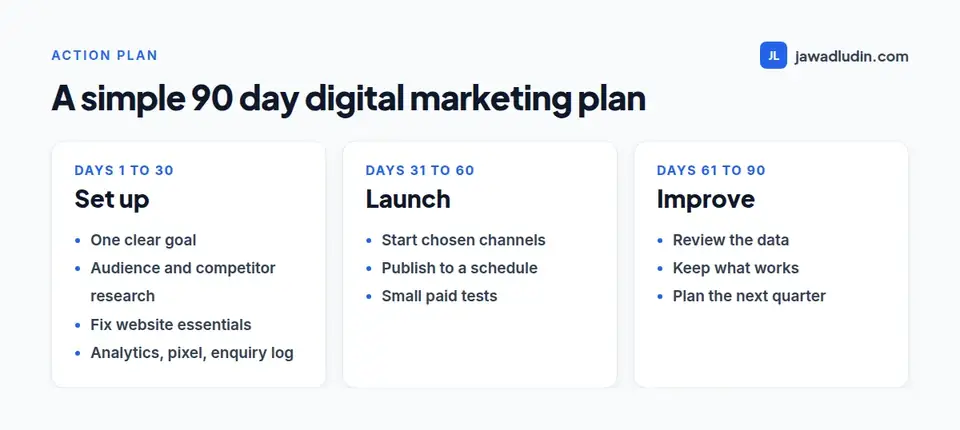
- Days 1 to 30: set one goal, research your audience and competitors, fix the essentials on your website, and set up Google Business Profile, Analytics, the Meta pixel and an enquiry log.
- Days 31 to 60: launch your chosen channels, publish content to a schedule and start small paid tests if they fit your goal.
- Days 61 to 90: review the data, keep what works, improve or stop what does not, and plan the next quarter with clearer numbers.
Digital marketing mistakes to avoid
- Buying followers, likes or fake reviews. They damage trust and teach the platforms nothing useful about your real audience.
- Running ads without tracking, or sending every ad to the home page.
- Relying on social media alone with no website you control.
- Using old statistics to plan today’s campaigns.
- Copying another company’s strategy without checking whether it fits your customers.
- Judging results after a few days instead of a few weeks.
Conclusion
Digital marketing in Afghanistan does not need to be complicated. Choose one goal, focus on the channels your customers really use, make your website and WhatsApp the place where enquiries arrive, and measure everything. Then improve your digital marketing strategy a little every month.
Looking for the best digital marketer in Afghanistan? Work with Jawad Ludin
I am Jawad Ludin, a Digital Marketing Manager and SEO Strategist with more than four years of hands on experience in SEO and Google Ads. I plan and run digital marketing that is built around your business goals: SEO, Google Ads, Meta ads, social media marketing, content strategy and lead generation, with tracking set up from day one. No inflated promises, just a clear plan and steady work.
Tell me about your business and your goals, and I will tell you where I would start. You can also see my experience.
Frequently asked questions about digital marketing in Afghanistan
Which social media platform is most used in Afghanistan?
By advertising reach, Facebook is the largest, with about 5.00 million people in late 2025 according to Meta’s tools as reported by DataReportal. Messenger and Instagram follow. These figures are revised often, so use them to understand scale rather than as exact counts.
How much should a small business spend on digital marketing?
There is no single correct number. Start with an amount you can afford to test for a month without pressure, measure the cost of each enquiry, and increase spending only on what proves it works. A small, tracked budget teaches you more than a large, untracked one.
Is digital marketing worth it when only a quarter of people are online?
For many businesses, yes. What matters is whether your own customers are online, not the national average. Businesses, professionals, students, urban customers and the diaspora are often reachable online. Target that audience precisely and keep offline channels for everyone else.
Do I need a website if I already have a Facebook page?
A Facebook page is useful, but you do not control it, and it rarely appears for the searches people make on Google. A simple, fast website gives you a permanent home for your information, supports SEO and makes your business look more established.
Should I hire a digital marketer or do it myself?
Many first steps, such as setting goals, posting consistently and answering messages, can be done by the owner or a team member. An experienced digital marketer in Afghanistan becomes valuable for paid ads, tracking, SEO and strategy, where mistakes cost money. Whoever you work with, keep ownership of your accounts and ask for clear monthly reporting.